











HIFIMAN stands among the most successful and innovative headphone builders in the business. Over the past two decades, they’ve continued to drive the performance of their planar magnetic headphones and other products with a unique approach to design and material application. Their latest effort, and the focus of this report, is the Arya WiFi, a complete headphone system intended for listeners who want the freedom of wireless matched with performance that might compete with many modest desktop systems. The Arya WiFi and its more accomplished partner, the HE1000 WiFi, are certainly unique products, intended for a specific segment of the personal audio community. The Arya WiFi’s Bluetooth mode supports LDAC, AptX, AptX HD, AAC, and SBC. Bluetooth is convenient, of course, but has its limitations. Bandwidth is key. Those who seek the higher peaks of playback know that a wired connection will deliver where wireless cannot. Today, and in this context, with a WiFi connection, we can experience a lossless stream direct to our ears. Very cool. HIFIMAN is offering a solution for those looking for an elevated and untethered listening experience.

They approached this challenge by constructing a single board that houses a power supply, both Bluetooth and WiFi receivers, a USB-C interface, a streaming processor, their Hymalaya Mini DAC (two in fact), and an amplifier. The power on offer hasn’t been published, but I can say there’s plenty. More on that below. All of this fits into the overall design, and with only a minor addition to the total weight (452g). For comparison, the Arya Unveiled weighs in at 413g. Impressive. To balance the added weight, they dropped it elsewhere, for one, with the updated composite headband design. As for the driver, they are using their NeoSupernano Diaphragm Gen.2, ultra-thin diaphragm, as well as their enhanced and Stealth magnet structure.

Setting up the Arya WiFi was straightforward. The manual, supplemented with a YouTube video detailing the connection and firmware update processes, covered all bases. I was able to update the firmware and then connect to my phone with no trouble. That said, some may find the old school connection and update methods inconvenient. I’d counter this by saying that it’s early days for this type of design. Maybe one day we’ll have an app to support these sophisticated headphone systems. HIFIMAN is updating the firmware at regular intervals, so we should see improvements to performance over time. I tested both wireless methods with my Android phone, using the Qobuz app as source. I found battery life was sufficient for my needs. However, when using Bluetooth, I did not run the power down entirely, so I can’t speak to the advertised run time. The WiFi stream sounded great, never dropped, and I got close to the claimed battery life. I found that a full charge took 4+ hours, which is very good considering the power requirements needed to drive an integrated system like this. I spent more time running the Arya WiFi tethered to my desktop via the included 2m USB cable. The desktop Qobuz app recognized the headphone immediately, and I experienced no interruptions. My sole recommendation/request would be finer volume controls.
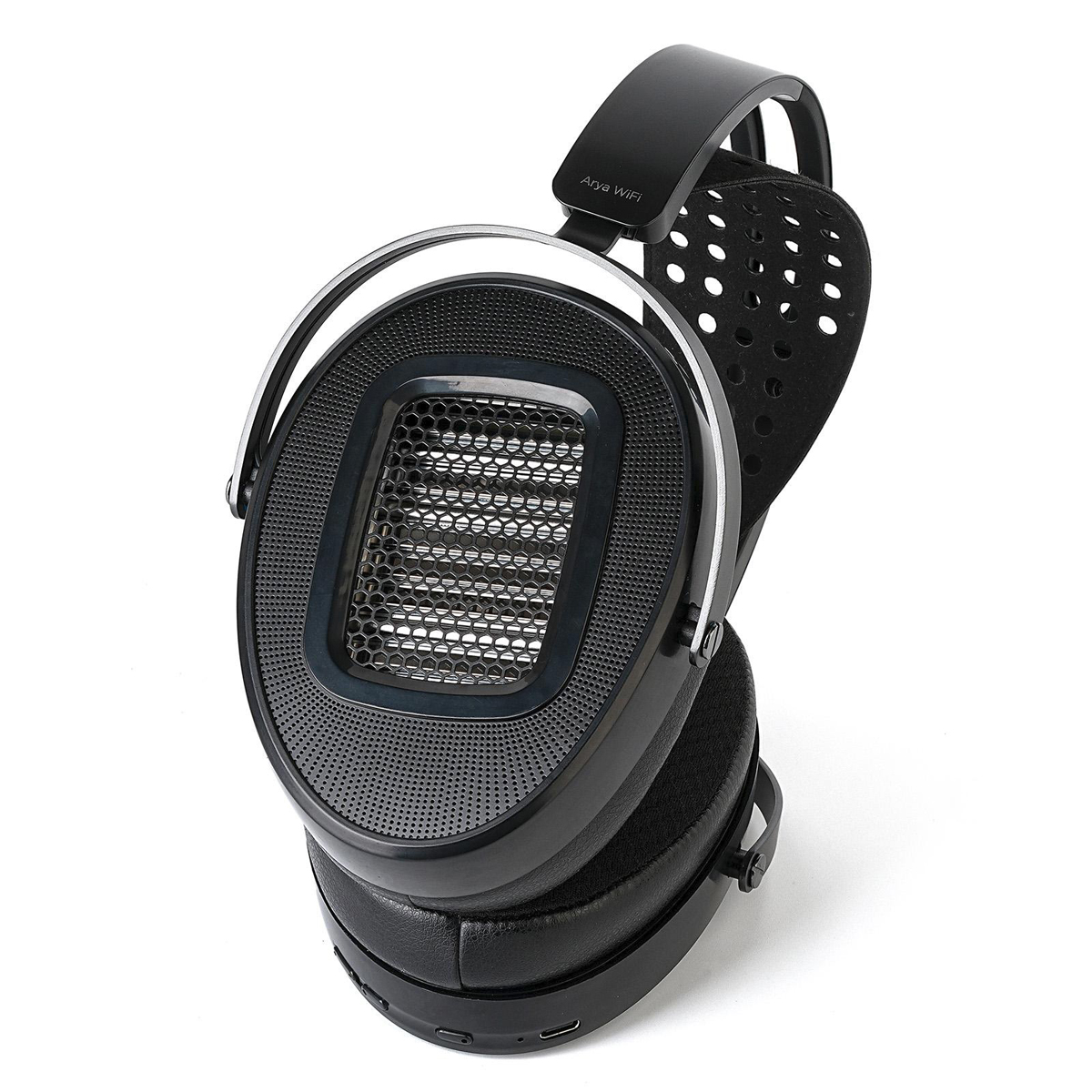
Strapped in, I found the Arya WiFi comfortable even through day-long listening sessions. The clamping force is relatively mild, the headband kept cool, and weight distribution is on a level we expect from a high-end planar headphone. The contoured ear pads I like a lot. All of this makes the Arya WiFi a good fit for my fairly large melon. Your mileage may vary.
As a value proposition, I see this product as an all-in-one system first, despite the fact that the wireless features are prioritized by HIFIMAN. Of course, WiFi streaming is an exciting feature, and those looking for a high-fidelity sound and an untethered listening experience should definitely give them a listen. I’ll add that this is also a product that could satisfy many listeners who simply don’t want to invest in separates but are looking for a taste of high-end playback. With standard wired headphones, listeners will use a wide variety of sources, DACs, and amplifiers, each experiencing a slightly different result. Here you’ll find consistent performance whether you are connected to your phone, tablet, or wired to a computer. Of course, the source matters too. So, if you find their sound appealing, then you’re done. No need to fuss with multiple components, wires, etc. Wired to my desktop, the Arya WiFi delivered great sound, which on its own makes this a remarkable product.
It would be very cool if I could connect them to the USB output on my Eversolo streamer, computers being the notoriously noisy sources that they are. I tried, briefly, and the Eversolo didn’t recognize the headphone. I’ve not looked too closely at this, and didn’t expect it to work. I’m curious. I am also curious about HIFIMAN’s approach to the voicing, as this type of integrated system provides designers an opportunity to get closer to one sonic target. In the past, this has been more common among two-channel systems – active loudspeakers – though it seems that this is going to change.
Listening
A note on my expectations going in, and something I’d hoped to hear from the Arya WiFi – immediacy. In theory, I’d expect to hear enhanced dynamic expression, immediacy, and dimension from an integrated headphone system like this. The signal path is very short, in comparison to a desktop system, for example. Everything is onboard, outside of the source. Noise levels should be very low. The Arya WiFi hits on all points, regardless of the musical choice. If you’re looking for even more of this goodness, then you might look to the HE1000 WiFi. Also, note that I did run them in for an extended period before getting into the focused listening sessions.
Larry Grenadier: Compassion/The Owl of Cranston:

The Arya WiFi delivered a very fine balance of string and bow, breath and body throughout this performance. The upper-midrange and high-frequency balance is quite good. The large studio space was illuminated well, though the instrument and player are quite close. And, key for this listener, it delivers a healthy chunk of the great bassist’s performance.
Kirk Knuffke – Lamplighter:

This excellent improvised session with two percussionists, Kenny Wolleson and Bill Goodwin, Stomu Takeishi on acoustic bass, and Knuffke’s horn was rendered big and bold. Instrument tone and timbre were very well represented. Cymbals had natural shine, color, and weight, again illustrating the Arya WiFi’s fine handling of high frequencies. Takeishi’s bass had the balance I expected – plenty of string action within the larger body. Bass drums were big and punchy. Lots of body, with help from that slight lift in the mid-bass. Better yet, the headphone delivered the group’s groovy interplay, though not to the level I am accustomed to with my desktop system. Not a fair comparison, I think. Point being, I am impressed with this integrated headphone system.
Talk Talk – Runeii:

The final track on the band’s 1991 release, “Laughing Stock”, is one I’ve heard more times than I can count, and on all formats except 8-track. This system wrangled a mix that can be murky and ephemeral in lesser systems. Hollis’ voice had a respectable amount of weight and shape. Despite the very quiet delivery, the system delivered something closer to a whole human, rather than a disembodied voice. The instruments were each grounded within the space and well rendered. The quietest of sounds were presented naturally. The depth of field was quite good.
Blackwater Holylight: Not Here Not Gone:

This track was suitably heavy, the wide-panned guitars each with a low center of gravity and plenty of grit. Keyboards floated above. Drums punched through the dense mix. Vocals were cleanly rendered above it all. The Arya WiFi will rock. There’s plenty of power on tap, and they never lose their grip. The gentle lift in the mid-bass adds satisfying weight to rock and pop tunes, and I found it didn’t muddy the midrange or sub bass delivery.
The Arya WiFi is a unique product and a great value for a certain segment of the personal audio space. Sonically, I found it delivers on all points. This alone makes it an impressive integrated headphone system. Add the connectivity options, and you’ve got a product you should strap into. Check it out. Or, if you’re one who prioritizes imaging and scale first and desire even more refinement, you might consider the HE1000 WiFi. Either way, I recommend sitting with HIFIMAN’s latest.
Thanks for listening.
Price $1,449
Manufacturer’s Website: https://hifiman.com/products/detail/362
Specifications
Frequency Response: 8Hz-55kHz ±0.5dB
THD+N: DAC: 0.0055% @-9dB, 1KHz
DAC+AMP: 0.009% @32Ω, 1KHz
Channel Separation: 105dB @1KHz
Net Weight: 452g
Operating Modes: WiFi, USB Audio, Bluetooth
Battery life under WiFi mode: 6.5-7.5 hours
Battery life under Bluetooth mode: 23 hours
Charging Time: 3-4 hours;
Standby Time: Over 30 days
Audio Formats: PCM 44.1KHz-768KHz, 32/24/16Bit, DSD native 64-512
Bluetooth Codecs: SBC/AAC/aptX/aptX HD/LDAC

Want to join discussion?
Feel free to contribute!