

AudioQuest (AQ) have been building high-quality cables, power products, portable DACs, and, briefly, headphones, for decades. I have used their products for a decade or more, and found them to be, without exception, reliable, effective, and built to last. My experience is limited to their entry-level and mid-level product lines. Recently, I had a chance to sit with one of their midline power conditioners and power cables.
The AudioQuest PowerQuest 707 has been in my system for a couple of weeks. The power conditioner and non-sacrificial surge protector currently sits as third tier in a group of four similar components, ranging from the PowerQuest 303 ($529.95) at the ground floor, the PowerQuest 505 ($849.95) second, and the PowerQuest 909 ($2499.95) at the top. Beyond this, the trio of Niagara products represent their highest-performing, more smartly dressed, and dearly priced power products. They also offer two more budget-friendly options, the PowerQuest 2 ($279.95) and PowerQuest 3 ($459.95), which is where I started some years back.
Design
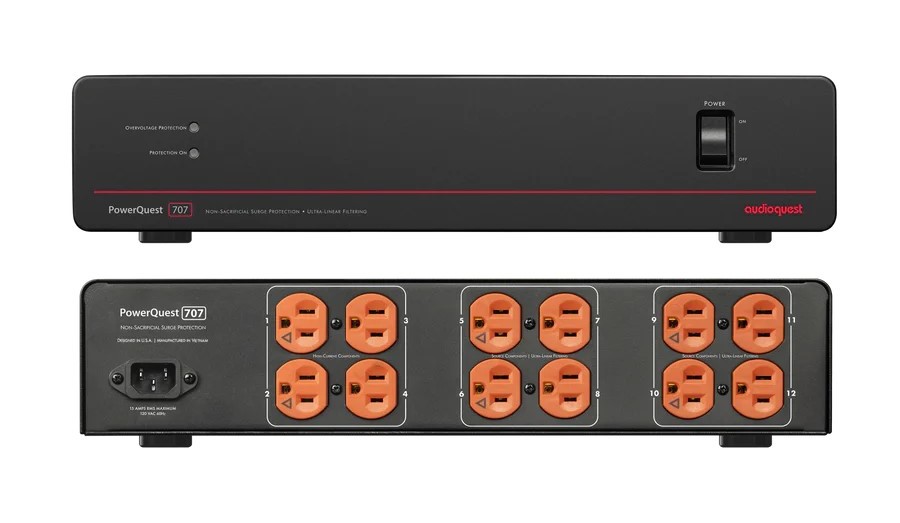
The PowerQuest 707’s design could fit (17″ W x 3.4″ H x 14.9″ L) into the rack in your home studio. The hardware (2RU rack ears) to do this is included. It will be right at home in your stack of hi-fi components too. The high quality build meets what I’ve come to expect from the company. Again, after many years using their headphones, DragonFly DACs, cables and power products, I’ve yet to experience any issues.
The minimalist matte black faceplate offers a single rocker switch on the right to power the unit on and off, along with two indicator lights on the left: one green, indicating that the unit is powered on, and one red, which will light when the unit detects an extreme voltage surge and has temporarily shut the circuit down. The left rear of the unit offers a single IEC (C13) input, so we can use whatever cable we like. They have included a high-quality 2m power cable (PQ-715) with a flat wall-side plug that utilizes their ZERO-Tech and RF/ND-Tech. The rest of the rear plate contains the 12 AC outlets, in three groups of four. The left-most group offers connection for four high-current components, like your favorite amplifiers. The other two groups of outlets, which utilize AudioQuest’s ultra-linear filtering, are recommended for source components. As always, you are encouraged to experiment and find for yourself how each type influences what you hear.
Features
The PQ-707 provides what AQ calls Extreme Voltage Shutdown: at 140VAC the main power relay opens, temporarily disconnecting the device from the grid, protecting your components from voltage spikes. Non-sacrificial surge protection shields your system from both voltage and current spikes (up to 6000V or 3000A). Transient Power Correction offers a current reserve of 45 amps, helping to fuel those dynamic swings we find in the most demanding recordings.
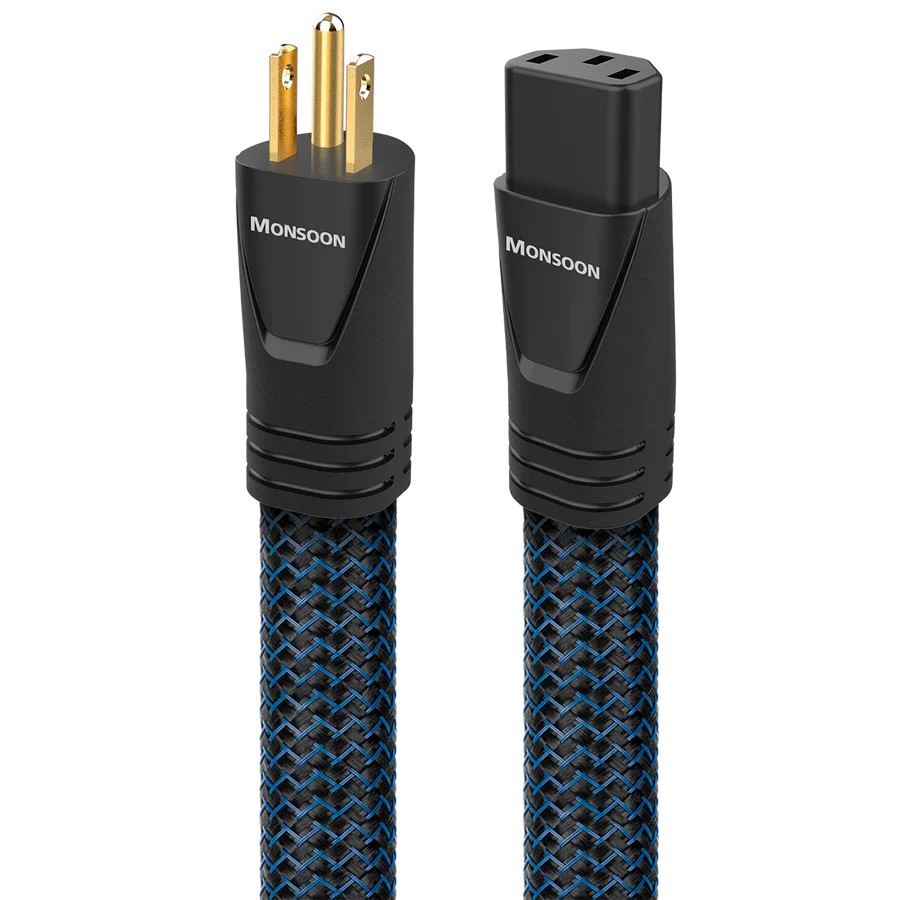
The Monsoon three-pole A/C power cable ($499.95 @1m) is a relatively heavy gauge (12 AWG), but it remains flexible, and I had no issues installing the 2m cable AQ provided into my system. Not sure I would go for a shorter length with this gauge; they tend to become less compliant. The cable features their Perfect-Surface Copper+ (PSC+) and Long-Grain Copper (LGC) copper conductors. AQ’s ZERO-Tech and RF/ND-Tech are employed here as well. More on the technology behind these designs can be found on the AudioQuest site.
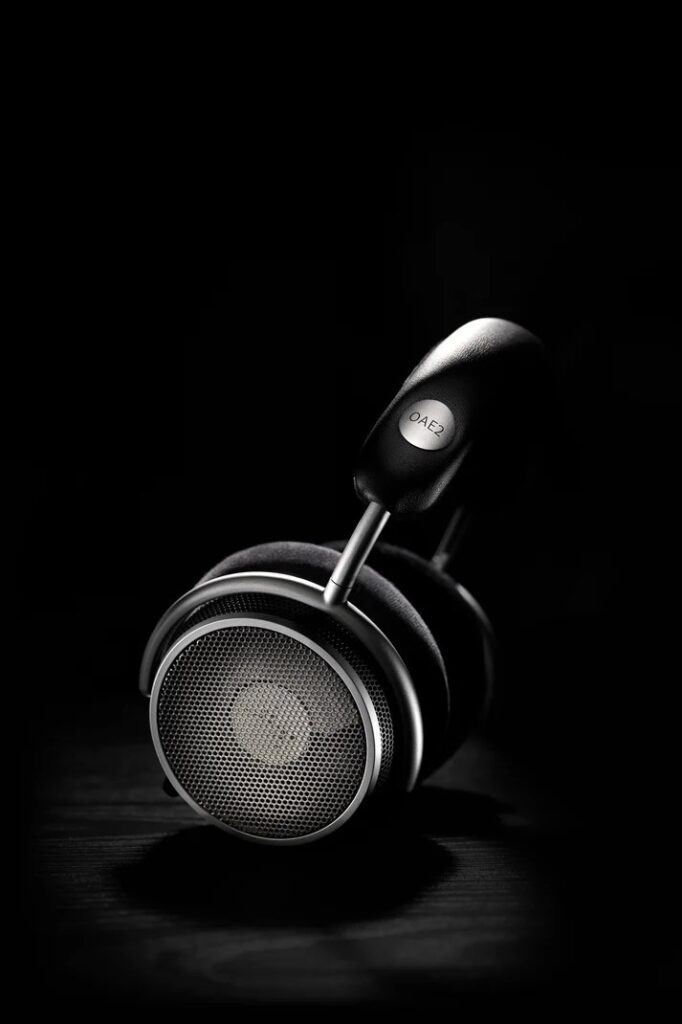
I set up the PowerQuest 707 within my desktop system, which has at its center the Enleum AMP-23R, fed by the Schiit Yggdrasil (v1+A2+gen5USB) and the Eversolo DMP-A6 as a dedicated streamer. The Grell Audio OAE2 is my reference dynamic driver headphone. Check the review here on H.G for more details on this remarkable pair. Qobuz is my source of choice.
In addition to the power conditioner, AQ provided the Monsoon power cable so I could experiment a bit. After running the unit for 150 hours or so (listening throughout) using the stock PQ-715 cable, I swapped the Monsoon in position between the wall and the unit, and ran the stock PQ-715 cable to the amplifier from one of the high-current outlets. This simply increased the many benefits the PQ-707 brought in its stock configuration.
My system, as it is, is deeply satisfying. The OAE2 is an excellent mate for the AMP-23R. The system as a whole delivers a SET-like immediacy, speed, color, and convincing tone. With the addition of the PQ-707, it’s doing one hell of a disappearing act. I’ll attempt to illustrate how I heard all of this below.
Signal to Noise

Adam O’Farrill’s “Elephant” was released in March of this year. This intimate recording of the quartet (O’Farrill (trumpet), Yvonne Rogers (piano), Walter Stinson (double bass), and Russell Holzman (drums)) feels close. Beyond the ambience on the trumpet, it’s relatively dry. That intimacy highlights all of the nuance in the band’s performance on “Curves and Convolutions”. With the PowerQuest 707 feeding my system, everything is more. Physical, colorful, and groovy. With fewer playback artifacts in the way, it’s easier to feel the performance. Not something we can measure, but who cares when we can feel the tension in a beautifully played line or rhythm. That’s no small feat.
Building Instrument – Manen, Armadillo
We needn’t lean in when the transmission is this insistent. “Bilverden” drifts up out of the inky black. Delay trails track endlessly, it seems. High frequency textures are remarkable; the bells have weight and tonal complexity. “Saunte” brings that elastic, lithe low end, and a slightly tacky texture.
“Bed on Fire” from Stian Westerhus & Pale Horses “Maelstrom” is a sprawling and dense tune driven by excellent performances from Westerhus and his bandmates. In this context, my system better decodes the many layers of voice, guitar, keyboards and drums. There is a clear separation of these textures within the impressively deep stage. This record can be murky at times, and here I find I’m less likely to lean in.
Summing
What does a quality power product do for us as listeners? More music, less noise. That’s it. I have found that well-designed products like the PowerQuest 707 will reveal much of the potential that resides within my systems. It’s not an EQ, so won’t change things you may not like about your system’s sound. What it will do is elevate what’s there by excavating the original audio signal. Consider that the A/C flowing in from the tap in our homes is, generally speaking, cruddy. Grimy. Strained. These aging networks were built for appliances and lighting, among other things, and not for highly sensitive musical devices. You may have heard stories about guitar players fussing over which outlet to plug their rig into. It’s a thing, at least, for some. When we sit down with a choice record, we are also listening to our local power grid.
Imagine a photo you’ve taken of a landscape blanketed in a light fog. From your view, objects’ colors are more and more desaturated the farther they sit from the lens, the deeper they sit within the image. The edges are softer, details are blurred, and the image depth is flattened somewhat. And, while our favorite components are often well-designed, and with particular focus around the power supply circuits, this noise remains. It colors what we hear through our loudspeakers and headphones. By removing the fog, we reveal the objects in their full color; their shapes stand out in bold relief, and image depth and scale expand. This, combined with the decompression of the overall image and the PQ-707’s ability to deliver additional current on demand, makes for a more engaging experience. Timing is everything. Music, like humans, only exists in time. To recreate (or approximate) the flow of any one performance, our systems require clean, stable power. To my ears, this heightened dynamic expression is the most remarkable and desirable result of installing a product like this in my system. It is not only about the big swings; it’s the smallest transients that bring music reproduction to life. The PowerQuest 707 (or perhaps another here that better meets your needs) should be on your list for audition.
Thanks for listening.
Thanks to AudioQuest for the loan.
PowerQuest 707 Specifications:
Market: Available in the United States & Canada
Power Cable Detachable PQ-715 / 2m Direction-Controlled
Zero-Tech RF/ND-Tech
Outlets 12 Total: (4) High-Current / (8) Source
Noise-Dissipation Differential-Mode: 8kHz-1GHz; More than
-22dB and Common-Mode: 30kHz-100MHz;
More than -22db
Maximum RMS Current 15 Amps (RMS) @ 120V
Transient Power Correction: 45 amps peak (up to 25mS)
Dimensions: 17” W x 3.4” H x 14.9” L
Manufacturer Site:AudioQuest.com
PowerQuest 707: $1599.95
Monsoon Power Cable: $499.95 @1m

Want to join discussion?
Feel free to contribute!