





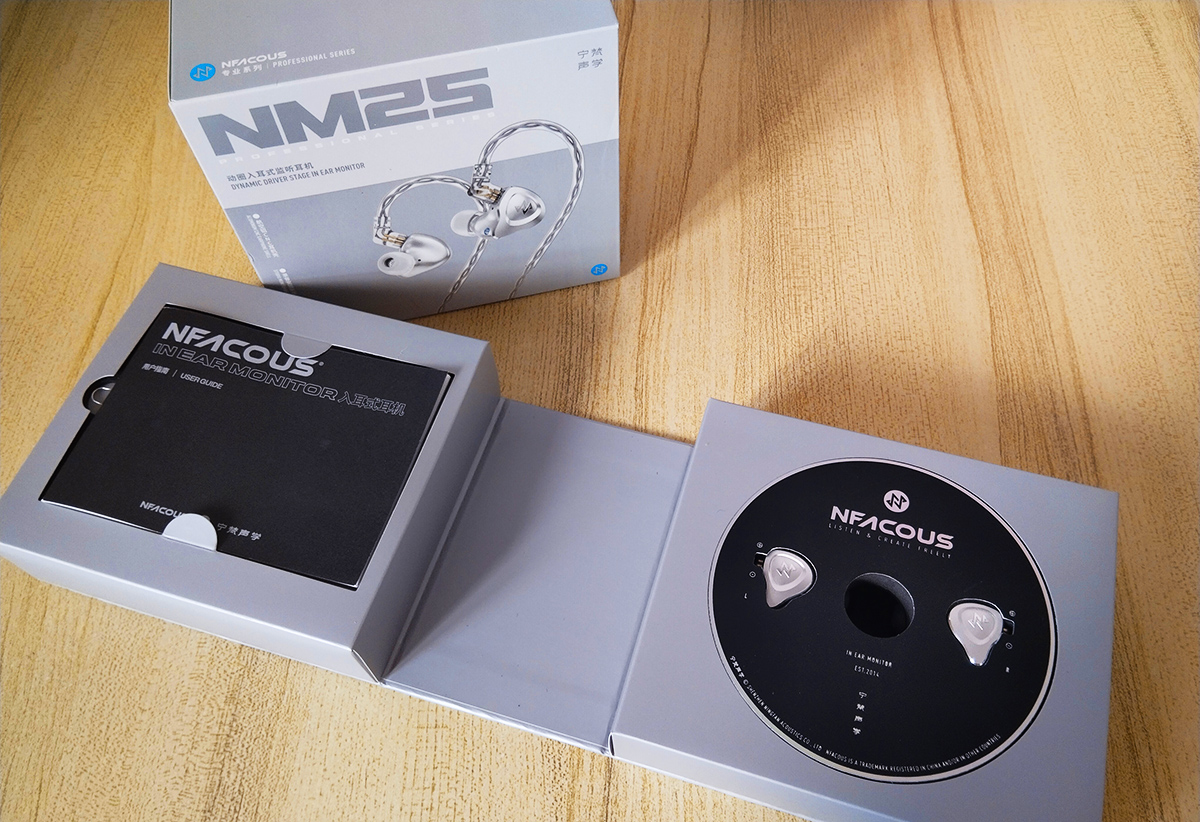
The NF ACOUS NM25 is a $199 dynamic in-ear headphone, positioned as a dual-purpose tool—equally suitable for studio monitoring and high-fidelity critical listening. At its core is a proprietary dual-magnetic-circuit, dual-chamber dynamic driver, combined with the patented Clutter Trap 2.0 acoustic technology.
At this price point, it sits alongside established options like the Shure SE425, though its tuning priorities are distinctly different—more analytical, less vocal-forward. After extensive testing, here’s the conclusion: buy the NM25 for transient speed and detail retrieval; skip it if you want warmth or forgiveness—this transducer does not flatter poor recordings.
The NM25’s standout advantage lies in its transient speed and dynamic performance—notes start cleanly and sharply, decay is crisp, and almost every note has a tactile sense of clarity. Its most obvious weakness is also tied to this unflinching trait: compressed recordings, pronounced sibilance, or harsh tracks will be instantly revealed, and peaks and troughs in the upper-mid frequencies become immediately noticeable.
Build, Comfort & Design
The NM25’s casing is machined from a single block of aerospace-grade aluminum using 5-axis CNC, and you can definitely tell. The contrast between the matte and polished finishes gives it a premium, almost jewelry-like feel, offering way better value than its $199 price tag.
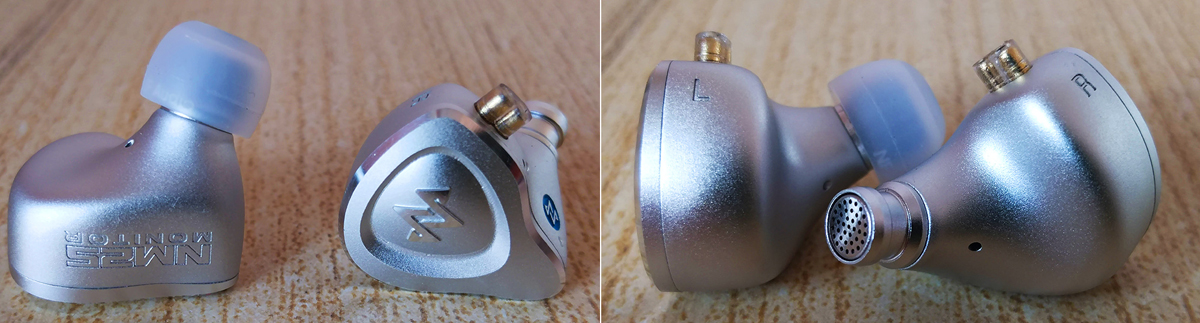
The tiny pressure-relief vents next to the nozzle and beside the cable connector serve as the acoustic tuning ports for the dual-chamber system.
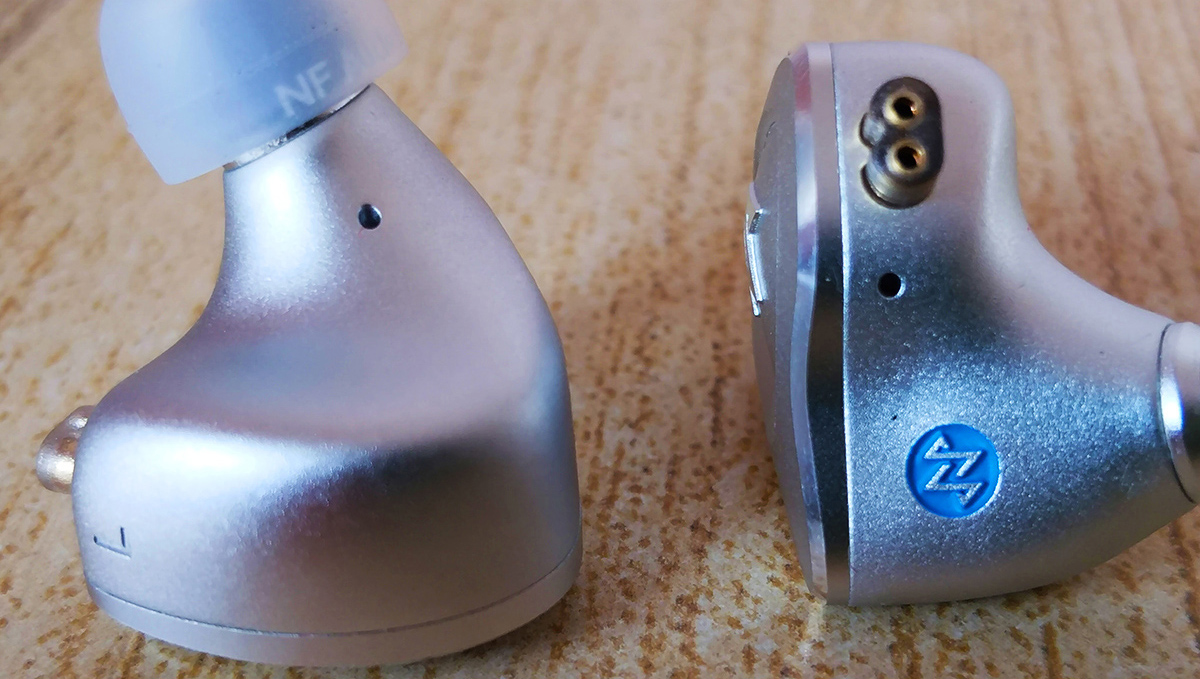
The 0.78mm two-pin recessed connector is a flat design to reduce stress on the plug during long-term use.
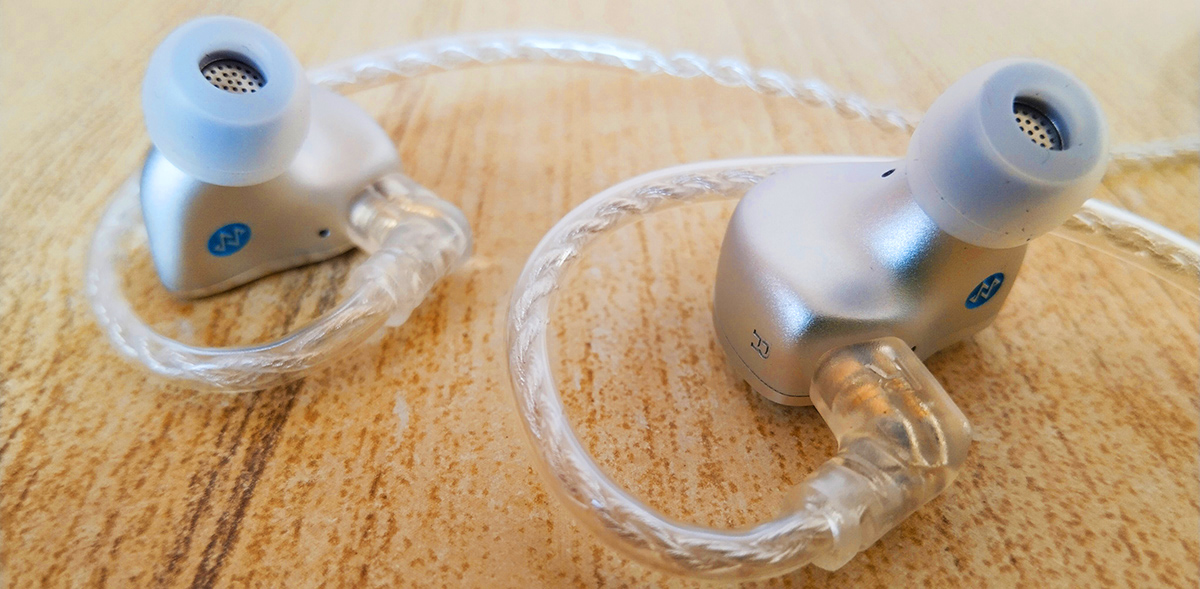
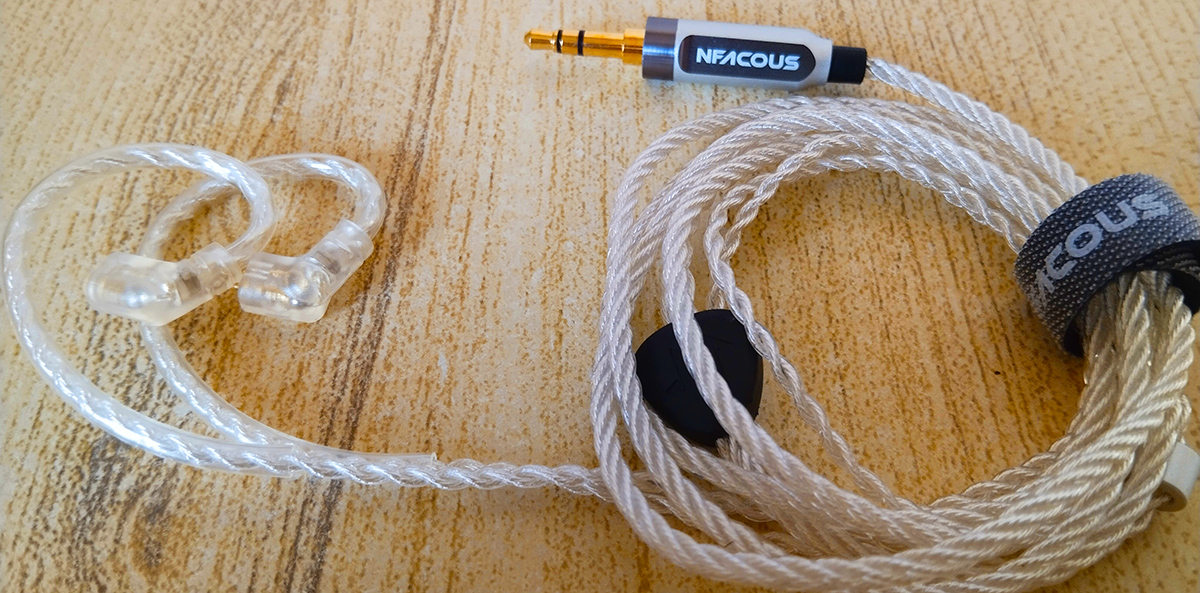
The included 5N OFC silver-plated copper cable is soft, has minimal microphonic interference, and comes with pre-shaped ear hooks that hold their shape well.
The ear-facing surface is sculpted with a contoured geometry—a design choice that appears informed by NF ACOUS’s experience in custom IEM manufacturing. In practice, the shell achieves a shallow-to-moderate fit that remained secure and comfortable throughout extended listening sessions.
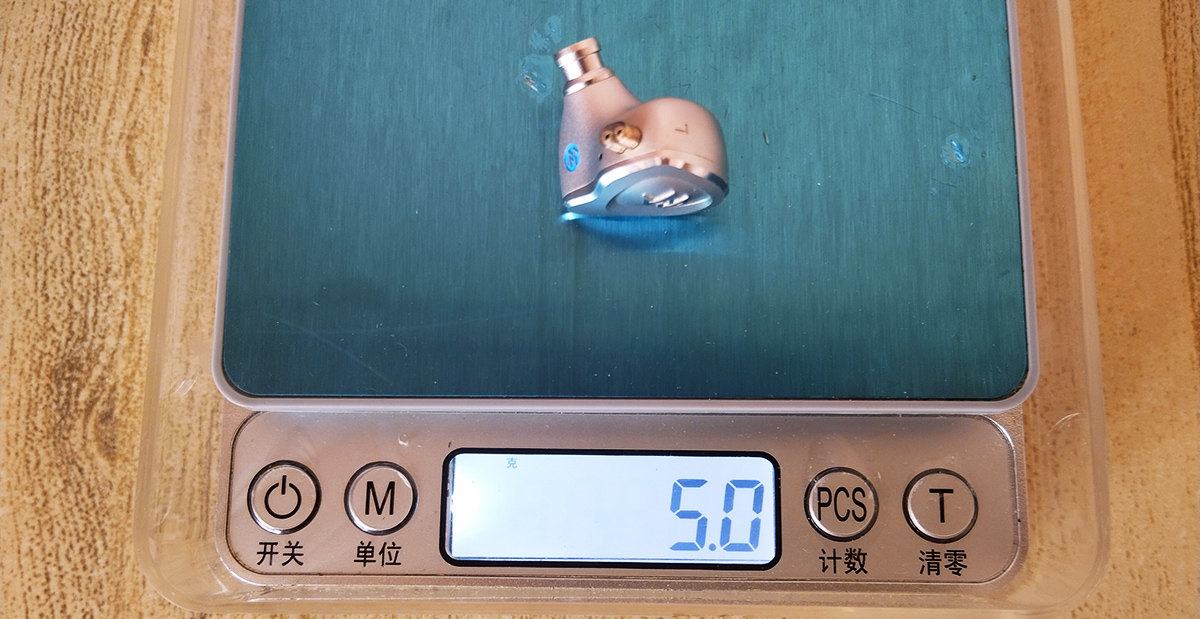
That comfort is further aided by the shell’s weight. On the scale, per side at 5g—light enough to remain practically unnoticeable during use, yet substantial enough to feel reassuringly solid in hand.
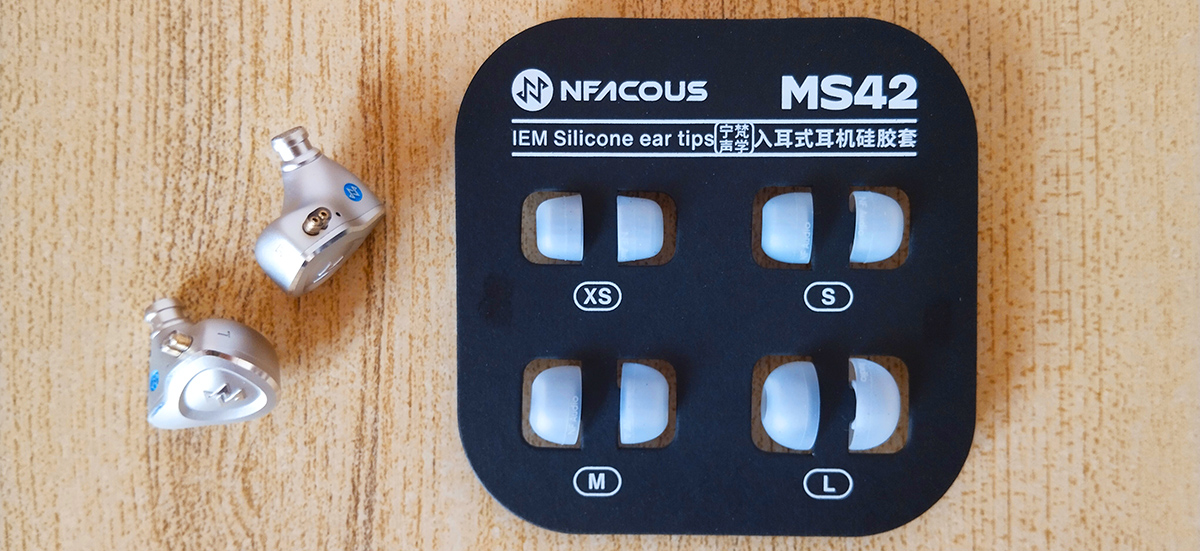
The included silicone ear tips (XS/S/M/L) are sufficient; swapping them for third-party foam tips (Comply or SpinFit) can further improve noise isolation and bass seal.
For people who wear glasses: no interference—the earphone shell fits well inside the ear. The 25dB passive noise isolation is enough to block office chatter and background noise, although it’s not as fully isolating as custom CIEMs. Leakage at moderate volume is almost negligible.
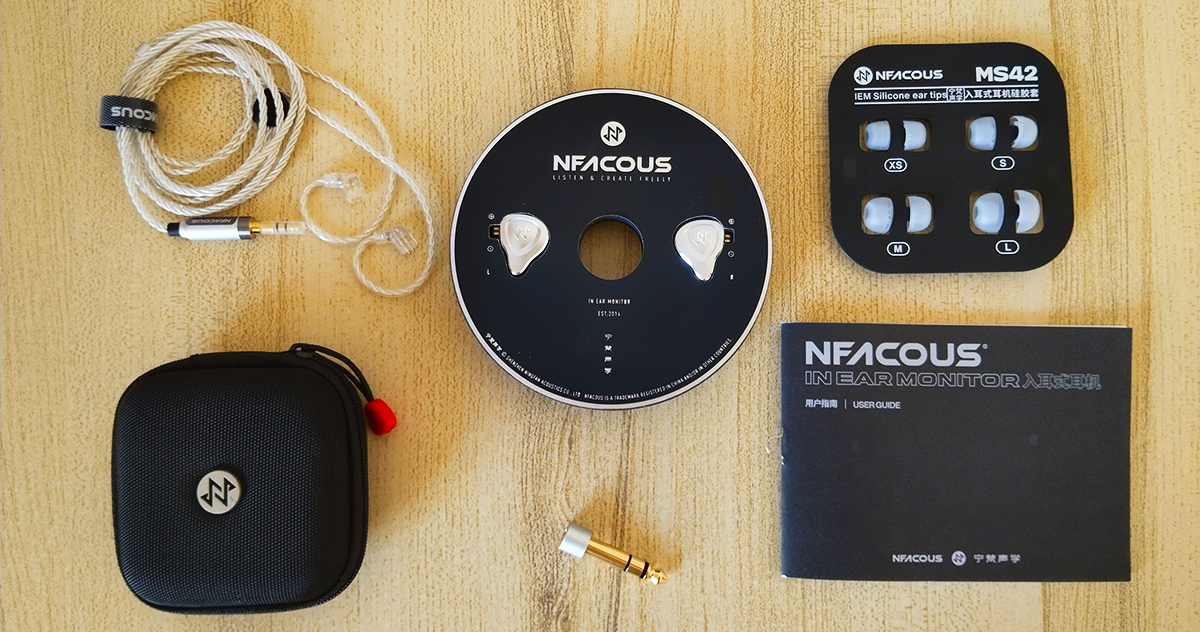
Packing List: Earphone*2, 0.78mm 2-pin 5N Cable*1, User Guide*1, Storage Box*1, Ear Tips*8 (XS, S, M, L), 3.5-6.35mm Adapter*1
Tech & Measurements
| Type | Closed-back In-Ear Monitor |
| Driver | 10mm Dynamic, Dual-Magnetic Circuit Dual-Chamber |
| Impedance | 32Ω |
| Sensitivity | 108dB/mW |
| Cable | Detachable 0.78mm 2-pin, 5N OFC Silver-Plated Copper |
| Price | $199 |
The NM25 uses a 10mm dynamic driver with a dual magnetic circuit and dual chamber design. Simply put: the dual magnetic circuit boosts magnetic flux density, which improves the driver’s control and response speed; while the dual chamber setup separates the front and rear cavities, reducing unwanted resonance.
The driver also features a ‘zoned damping system,’ applying different resistance across various areas of the diaphragm to balance out air-driving characteristics in the low and mid-high frequencies.
Even more importantly, there’s the Clutter Trap 2.0—a finely tuned Helmholtz resonator around 5kHz—that acts as a physical equalizer, cutting down on the inherent quarter-wave resonance peaks in IEM design.
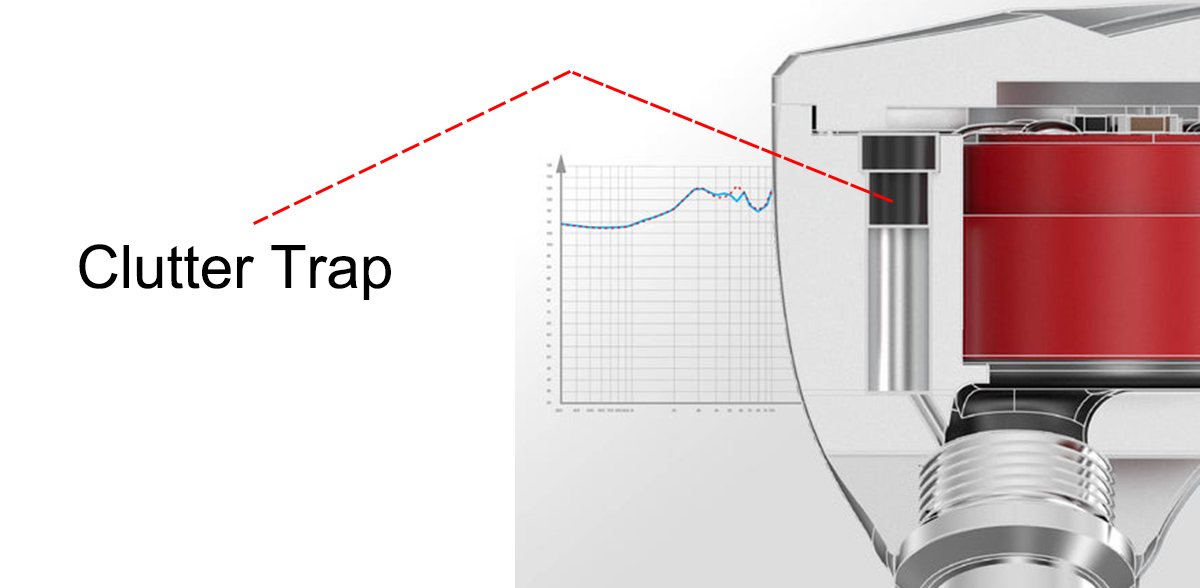
Traditional methods usually rely on heavy damping to suppress resonance, but that can dull transient response; the Helmholtz approach achieves the same attenuation without sacrificing speed, while keeping punches and detail intact.
Measurements (Based on Official Frequency Response Graph)
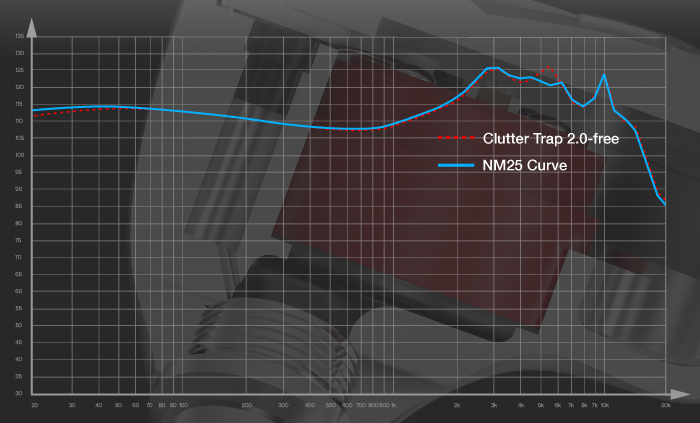
The official NM25 Curve reveals the following characteristics:
Distortion (THD): Specified at <1%. Under normal listening levels, distortion is not audibly intrusive—the driver remains clean and controlled.
Impedance & Drivability: Rated at 32Ω, the NM25 is easily driven from a smartphone dongle. In testing, the RME Babyface Pro’s dedicated output provided slightly tighter low-end control and improved dynamics compared to portable sources, though the difference was subtle.
Sound Quality
Test Setup: MacBook Pro → RME Babyface Pro (USB audio interface) → 3.5mm to 6.35mm adapter → 6.35mm single-ended output (original NM25 accessory)
Playlist:

Bass
- Quantity: Lean to moderate—this is not a V-shaped tuning.
- Depth & Texture: Consistent with the frequency response, sub-bass below 40Hz is limited in energy. The low synth and organ pedal tones in “Time” are audible in outline but lack physical authority. Bass guitar articulation is clear and well-separated.
- Transient: Exceptional. On ‘Give Life Back to Music,’ the muted funk guitar strums are crisp and defined, with lightning-fast attack and zero smear into the midrange—entirely consistent with the clean lift/roll-off character visible in the frequency response.
- Compared to Sony IER-M7: The IER-M7 delivers more authoritative sub-bass extension and texture, closer to what you’d expect from a reference-grade monitor; the NM25 trades low-end weight for speed and clarity, making it better suited for rhythm tracking where transient precision takes priority over heft.
Mids
- Vocal placement: slightly back—not recessed, just a step backward. In ‘Gravity,’ Mayer’s vocals feel like they’re positioned a bit further back rather than right up close, creating a ‘stage perspective’ rather than a ‘whisper’ effect. This is directly related to the slight dip around 3kHz in the frequency response—a key area that defines a vocal’s presence and intimacy.
- Timbre: Neutral-lean. Acoustic guitars and saxophones sound accurately rendered but lack the body that warmer tunings impart. Fingerstyle guitar detail (nail attack, body resonance) is meticulously separated, though the instrument’s fundamental “woodiness” feels somewhat thin. The smooth downward tilt from 1kHz to 2kHz contributes to this leaner presentation—detail is clear, but warmth is subtly reduced.
- The 3kHz Region: This is the NM25’s most polarizing design decision. The gentle 3kHz recession pushes vocals and lead instruments slightly rearward, earning a wider perceived soundstage and reduced listening fatigue—at the cost of pop vocal “bite” and emotional immediacy. For monitoring applications, this means less “flattering” coloration and more objective presentation.
- Recording Tolerance: Low. This monitor exposes sibilance, compression artifacts, and leveling issues with surgical precision. Every flaw in Radiohead’s dense arrangements is laid bare.
- Compared to Shure SE425: The SE425 presents a more forward, vocal-focused midrange with greater smoothness, while the NM25 offers superior upper-midrange resolution and detail retrieval.
Treble
- Extension: Adequate but not excessive. The Clutter Trap 2.0 effectively controls the 5kHz region—cymbals and hi-hats present metallic texture without piercing overtones. The gradual roll-off above 6kHz evident in the FR graph translates as a “professionally restrained” top end that neither flatters nor withholds information.
- Bright vs. Smooth: Bright-leaning but controlled. The NM25 avoids outright sibilance, though treble-sensitive listeners may experience fatigue after 60-90 minutes at elevated volumes.
- Detail Retrieval: Outstanding for the price—I caught breath noises and fret slides on “Paranoid Android” that I’d previously missed.
Soundstage & Imaging
- Width/Depth: Moderate width—not cavernous like a full-size open-back, but above average for an IEM. Depth is more impressive, with front-to-back layering that places vocals ahead of drums, drums ahead of ambience, and clear separation between planes. On “Time,” the orchestral string layers and synth walls are mapped with tangible depth.
- Imaging Precision: Excellent. This is the NM25’s standout spatial trait. On “So What,” the trumpet, sax, piano, bass, and drums occupy distinct, stable positions in the phantom center with zero smear or drift—genuinely monitoring-grade imaging.
Dynamics & Transients
- Microdynamics: The NM25 excels at the smallest dynamic shifts—Mayer’s fingertip pressure variations, a softly brushed snare, the decay tail of a piano note. This is where the dual-magnetic circuit earns its keep.
- Macrodynamics: Transitions from pianissimo to fortissimo are clean and resolved. The crescendos in “Time” are delivered with complete dynamic integrity.
- Speed: Fast, clean, and agile. Complex metal passages (“Enter Sandman”) render without mud, though drum presentation may leave hard-rock listeners wanting more weight.
Overall Tonality
Neutral-bright with lean bass and a deliberate 3kHz recession that pushes vocals slightly rearward. This is a monitoring tool first, a listening IEM second. It excels with acoustic jazz, classical, well-mastered rock, and critical listening. It struggles with poorly mastered pop or any material that benefits from warm, forgiving coloration. The 3kHz dip trades vocal intimacy for reduced listening fatigue and a wider perceived stage.
Best suited for: Acoustic instruments, jazz, classical, critical listening, studio monitoring, analytical audiophile sessions.
In Use: Real-World Scenarios
Studio / Professional Use
- Recording Monitoring: Excellent. Transient precision and detail retrieval allow vocalists and instrumentalists to hear every nuance of their performance—breath control, articulation, pitch accuracy. The lean bass prevents low-end masking of critical midrange cues.
- Mixing/Mastering: Imaging and frequency balance are accurate enough for rough mixes. The 3kHz recession requires careful interpretation: vocal balances set on the NM25 may translate with more presence on smoother monitors. Cross-reference with other systems is strongly advised.
- Fatigue: While the physical comfort is commendable—the ergonomic design of the shell supports long hours of wear without hot spots—the tuning itself brings another limitation. With a thinner low end and brighter highs, most listeners start to feel ear fatigue after about 2 hours. Even though the Clutter Trap 2.0 controls the 5kHz range, long-term use can still feel a bit tiring. If you’re sensitive to highs, you might treat it as a 2-hour monitoring device rather than an all-day companion.
Hi-Fi / Leisure Listening
- Immersion: When the recording is pristine, the NM25 is transporting—the imaging and detail create a “you are there” experience. With lesser recordings, the magic evaporates.
- Emotional Engagement: This is not a “romantic” IEM. It won’t add warmth or sweetness to a clinical performance. It will, however, reveal the subtle emotional inflections in a pianist’s touch or a vocalist’s breath. If you value transparency over euphonics, the NM25 delivers.
Limitations
- Sub-bass roll-off limits authority: The frequency response shows clear attenuation below 40Hz. On material like “Time” that relies on deep organ pedal and synth sub-bass, the NM25 lacks the physical authority and immersion required for large-scale orchestral or electronic music.
- 3kHz recession reduces vocal intimacy: The deliberate dip at 3kHz pushes vocals and lead instruments rearward. While this reduces listening fatigue, pop and rock listeners who crave upfront vocal presence may find the presentation lacking immediacy and emotional engagement.
- Lean lower midrange robs instrumental body: The gentle downward tilt from 1kHz to 2kHz means instruments like acoustic guitars, cellos, and baritone vocals lack some of the warmth and fullness that a flatter tuning would provide.
- Ruthlessly revealing with subpar recordings: The NM25’s transparency is a double-edged sword—it exposes mastering flaws, sibilance, and compression artifacts that forgiving IEMs would smooth over. Unsuitable for casual listening with low-bitrate streaming or poorly produced tracks.
- Treble can fatigue over long sessions: Despite the Helmholtz resonator controlling the 5kHz peak, the elevated presence region is aggressive enough that sensitive listeners may experience listening fatigue after 60-90 minutes at higher volume levels.
Summary
The NF ACOUS NM25 is a $199 in-ear headphone that exceeds its price range in transient speed, imaging accuracy, and build quality.
It features a diffuse-field reference tuning designed for studio monitoring and analytical listening. Its dual-magnet driver and Clutter Trap 2.0 Helmholtz resonator strike an impressive balance between detail retrieval and listenability.
However, its low-frequency extension is limited, the lower mids are slightly thin, and there’s a deliberate dip around 3kHz, which may limit its suitability for certain music genres and listening preferences—it’s not a ‘smooth’ or ‘warm’ headphone; it’s a precise monitoring earphone that reveals details.
Compared to the Shure SE425, the NM25 offers higher resolution and better ergonomics at a lower price. Compared to the more expensive Sony IER-M7, it falls a bit short in low-end thickness and midrange richness but still provides surprisingly good monitoring value for just over half the cost.
Approach it as a monitoring tool or critical listening reference—it’s best suited for dedicated listening sessions rather than casual all-day wear.
One-Liner Buy/Dodge Advice
Buy it if: You’re a musician, producer, or critical listener who values transient speed, imaging precision, and detail retrieval, and you need a comfortable long-wear monitor—you’re willing to accept a lean, revealing presentation over a warm, forgiving one.
Skip it if: You primarily listen to EDM, hip-hop, or large-scale orchestral works, if you crave “chest-thumping” bass and “close-up” vocals, or if you prefer a warm, smooth, liquid tonal presentation.
| Pros: Reference-grade DF-style frequency response Elite transient speed and dynamic articulation 5-axis CNC aerospace aluminum build with premium fit and finish Ergonomics derived from custom IEM expertise | Cons: Lean lower midrange robs instruments of body and warmth Ruthlessly revealing—unforgiving with poor recordings Bright-leaning tuning may fatigue treble-sensitive listeners Sub-bass roll-off limits authority in large-scale orchestral/electronic music |

Want to join discussion?
Feel free to contribute!