

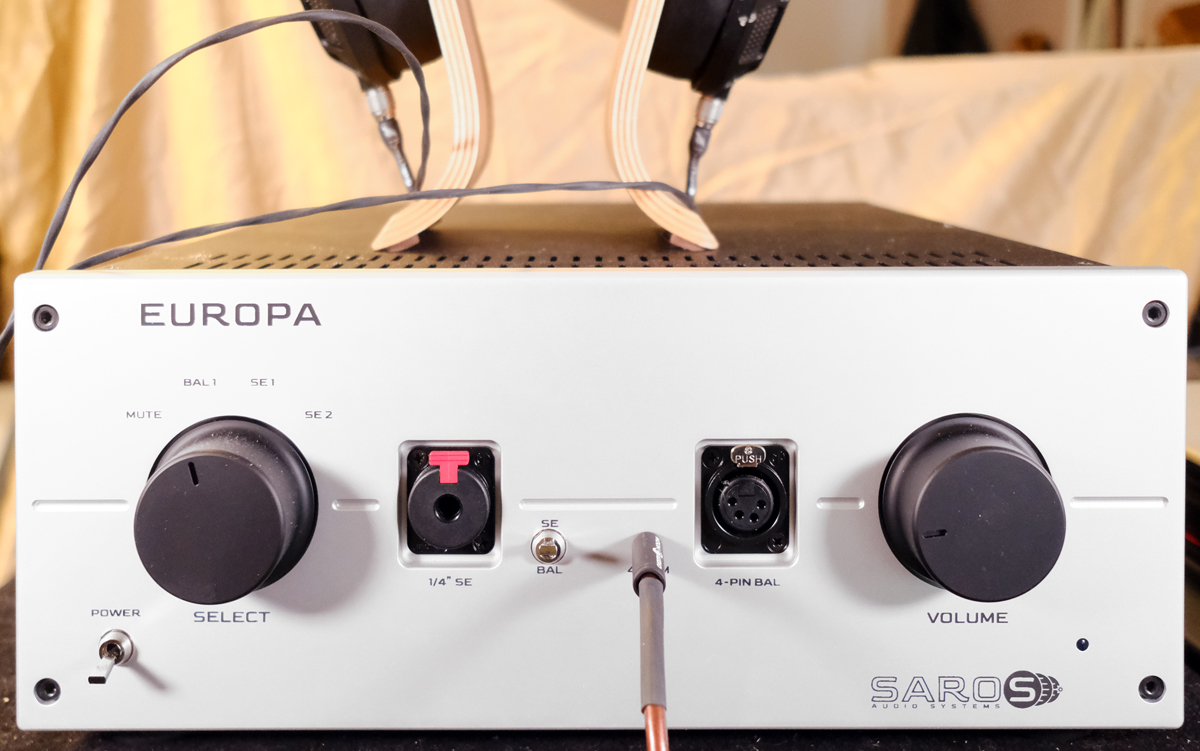
Regular readers will know that I have a soft spot for tube amps. Beyond the greater resolution of sound that comes with the elimination of transient intermodulation distortion, there is a natural musicality to the midrange that makes it feel like you are listening to real instruments rather than a recording. So, it will be of no surprise that I have waited with great anticipation since Moon Audio’s CEO Drew Baird, P.E., first showed their new Saros Audio Systems Europa Fully Differential Tube Headphone Amplifier to get a hold of a review sample. That time is finally here.
Saros Audio Systems Europa Fully Differential Tube Headphone Amplifier
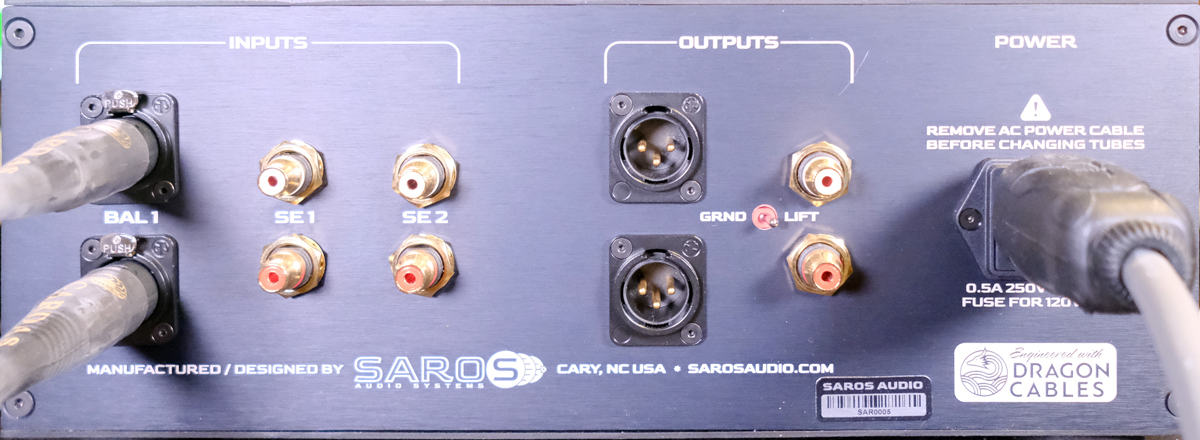
Ok, there is a lot to unpack when discussing the Saros Audio Systems Europa Fully Differential Tube Headphone Amplifier. Let’s begin with architecture: the Europa is fully differential (i.e., balanced) from input to output. This is accomplished by having premium Lundahl transformers at both the input and at the output. At the input side, the transformer converts the single-ended inputs to differential or maintains the natural differential aspect of the balanced inputs. This allows for a negative signal in relation to ground as well as a positive signal, and completely separates the right channel signal path from the left channel signal path. By using dual triode tubes, they are able to create two matched single-ended triode amplifiers, one positive and one negative, in what is known as a push-pull configuration, effectively quadrupling the power while retaining most of the benefits of the single-ended triode. (The basic advantages to a push-pull amplifier beyond increased power are that noise and distortion that is common to both amplifiers is eliminated, and noise and distortion that is not common, while additive, is halved relative to the output. The drawback to the design is that no two amplifiers are perfectly identical, which can lead to some loss of micro-detail.) There are, in turn, two amplification stages, preamp and output, which are in turn connected to the output transformer allowing for either balanced or single-ended output.
This is all accomplished using only audiophile-grade components, including five premium Lundahl transformers, Elma stepped attenuators, audiophile-grade VPG Z-Foil and Vishay resistors, Mundorf capacitors, and Moon Audio Bronze Dragon Graphene UPOCC Copper wire for signal path wiring, in a painstaking hand assembly process that includes a 12-hour burn-in and rigorous testing regimen.
Let’s talk about power supplies. I have always said that the most important part of an amplifier is the power supply. To quote Moon Audio’s product page, “The Europa Tube Amplifier’s power supply is built to reference standards, recognizing that clean, stable power is fundamental to exceptional audio performance. A Lundahl Power Transformer provides high voltage, tube heater voltages, and logic level voltages.
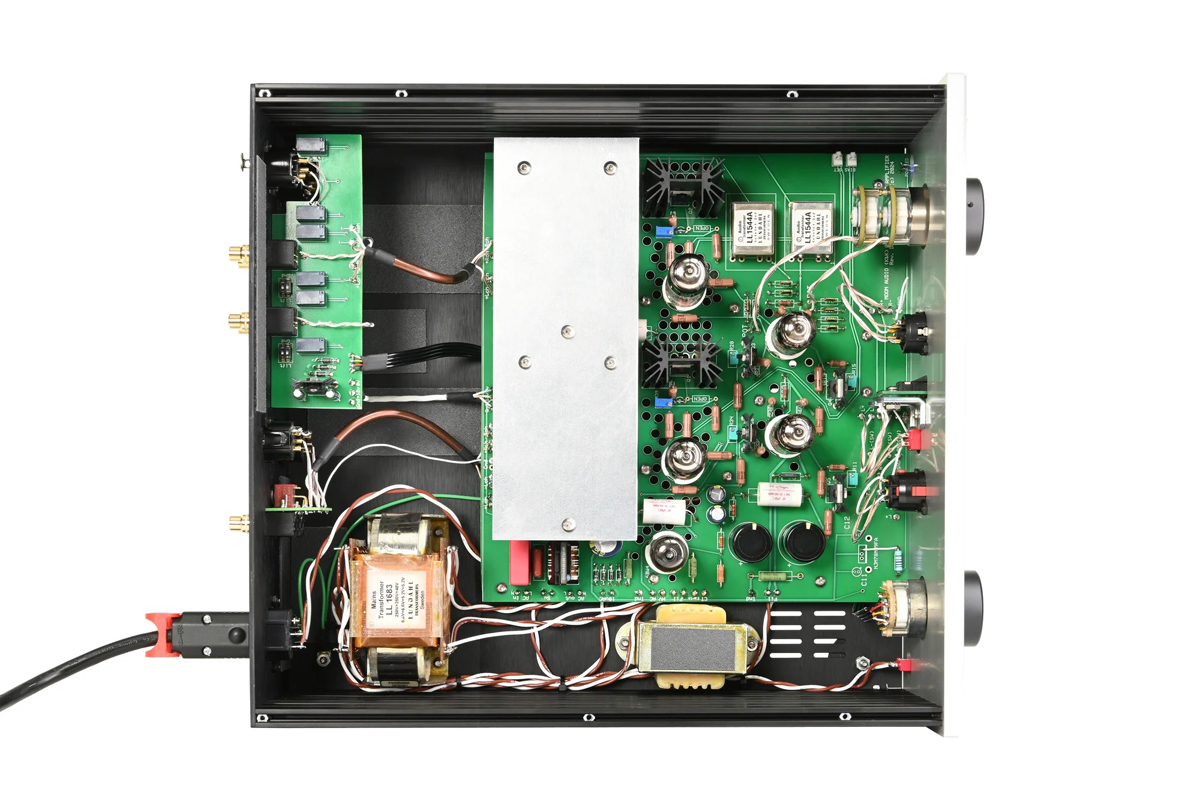
High-voltage rectification is handled by the 6BW4 Vacuum Rectifier Tube, followed by extensive filtering with premium Mundorf Capacitors (both Electrolytic and MKP types). A Hammond Choke provides additional filtering and regulation of the B+ power supply, effectively removing AC ripple while maintaining excellent transient response. Low-voltage DC rails are filtered using high-quality Panasonic capacitors. All critical signal level resistors are VPG Ultra High Precision, Z-Foil Audio Resistors, and all other Resistors are from DALE.”
Living with the Saros Audio Systems Europa Fully Differential Tube Headphone Amplifier
Of course, all of this is really only important if it is translated to good sound, and the real test is to listen. The unit I received was pre-broken in, having been used at shows and by other reviewers, meaning I skipped that to minimize wear on the tubes (though I am assured that the tubes are run at a minimal bias to preserve tube life). I note that the Europa came with a special cable that can be connected to any voltmeter to facilitate biasing when tube rolling.
My initial listening tests were performed using my reference system: dCS Bartók APEX DAC with Headphone Amplifier (as DAC ), Black Dragon USB Cable, Black Dragon Power Cables, and Core Power Technologies A/V Equi=Core 1000.
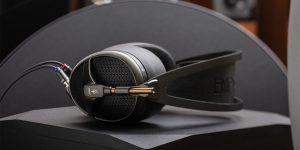
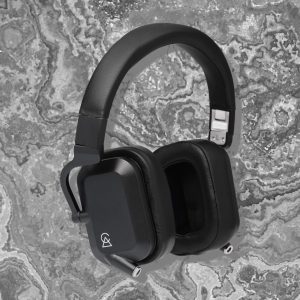
For headphones, I plan to use a gamut as usual, though primarily the Dan Clark Audio STEALTH, for which Moon Audio provided a 10’ 4.4mm TRRRS Bronze Dragon Cable, and the HIFIMAN SUSVARA UNVEILED, for which I already had a 10’ 4-pin XLR Bronze Dragon Cable.
Starting with the STEALTH, I opened up Qobuz on the Bartók APEX and selected Neil Young & The Chrome Hearts’ latest release “Second Song” (24-bit/192kHz – Qobuz). The overall impression was laid-back musicality, well in tune with the tune itself. The soundstage was massive; the piano had an upright character to it, the bass did too, and the detail of the competing guitars came through the delicate percussion clearly.

Next up was “The Shel Talmy Recordings” (16-bit/44.1kHz – Qobuz), a collection of early David Bowie songs (as Davie Jones & The Lower Third). The Europa fed you that early sixties psychedelic live studio recording unfiltered, while retaining a sense of musicality and real feel of that large studio.

“BABE: ELABORATIO A Tribute To My Mother” (24-bit/48kHz – Qobuz) by Harry Connick Jr., which takes a lot of its cues from Gershwin, featured some very dynamic piano with the subtlety of a Steinway. Recorded at Iwaki Auditorium in Melbourne, Australia with the Orchestra Victoria, the sense of space is visceral, and each of the 70 musicians lives in their own private space. The timbre of instruments was so real and musical, one could picture being there.

Switching to the SUSVARA UNVEILED, I decided to pick selections from my regular playlist, starting with Philip Glass’ “Koyaanisqatsi” (24-bit/96kHz); the massive pipe organ is laid bare in its epic resonance and huge soundstage. Again, musicality is key, which is essential to the enjoyment of this headphone.

The clarity, openness, resolution, and decay of the cymbals for “House of the Rising Sun” (“The Animals”- 24-bit/96kHz) performed by The Animals was noteworthy, as was the ability of the Europa to separate the mélange of sound from the overlapping instrumentation. One could almost picture oneself attending a private performance in an empty auditorium.
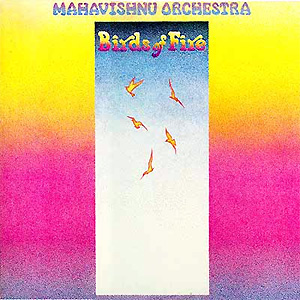
I decided next to play my detail torture test “Birds of Fire”(“Birds of Fire” – 16-bit/44.1kHz) by Mahavishnu Orchestra, with two tracks from each musician competing in a cacophony of sound; clarity and articulation were the watchwords, and as with everything else, musicality and soundstage were supreme.
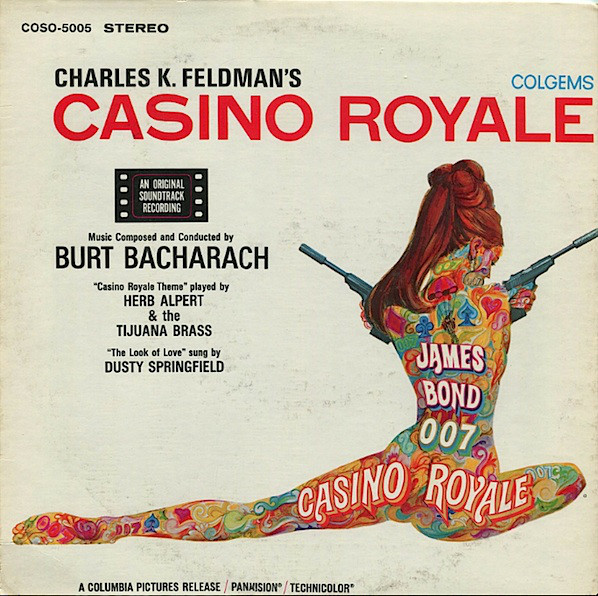
Moving on to another hard-to-drive headphone, the Spirit Torino Twin Pulse Isobaric Open Circumaural Headphone, which demands lots of power not for volume but control, and the Europa did not disappoint, playing Burt Bacharach’s “Casino Royale Theme” (“Casino Royale” – 24-bit/192kHz) as performed by Herb Alpert and the Tijuana Brass, providing all the dynamics that define brass, with tight, snappy percussion.

Next, I moved in the opposite direction; to test noise floor, I selected my most efficient headphone the Grado Labs GSX3000x, which are comparable to IEMs in sensitivity and therefore demand extremely quiet amplifiers. At full volume via the single-ended output, the Europa was dead silent. I then put on Satchmo’s “What a Wonderful World” (“What a Wonderful World” – Louis Armstrong – 24-bit/192kHz) at about one quarter volume, and once again the soundstage was massive, and the musicality was overwhelming; the low-level detail enhanced by the magnificent noise floor.
Conclusions on the Saros Audio Systems Europa Fully Differential Tube Headphone Amplifier
The Saros Audio Systems Europa Fully Differential Tube Headphone Amplifier does everything a tube headphone amplifier is meant to do; let’s back up a little, the Europa does everything a headphone amplifier is meant to do, and does it in a manner which only tube amplifiers can. A linear tonal balance throughout the audible spectrum, a musicality of midrange that makes even the blare of horns pleasant to listen to, a dynamic range able to reproduce the blare of horns, a resolution of sound that is almost the sole province of tube amps, a stellar noise floor, connectivity that accommodates most headphones and sources, and a build quality that reflects the heart and soul put into its sound quality.
The Europa is unquestionably the best headphone amplifier that I have paired up with the dCS DAC and without a doubt superior to the internal headphone amplifier. It is numbered among my favorite amplifiers that I have reviewed. While it sits at the high side of mid-priced reference amplifiers, it more than justifies that price in performance and build quality. Two thumbs up, congrats, Drew, you have done it again.
Price:$8,995
Manufacturer’s Website: https://www.moon-audio.com/products/saros-audio-europa-fully-differential-tube-headphone-amplifier
Specifications:
| Parameter | Specification |
| Input/Output Specifications | |
| Analog Inputs | 1x XLR Balanced 2x RCA Single-Ended |
| Preamplifier Outputs | 1x XLR Balanced 1x RCA Single-Ended |
| Headphone Outputs | Balanced: 4-pin XLR, 4.4mm TRRRS Unbalanced: 6.3mm ¼” |
| Compatible Headphones | 16 – 600 Ω (impedance) 74 dB – 120 dB (sensitivity range) |
| Audio Specifications | |
| Frequency Response | 10 Hz – 20 kHz |
| Output Impedance | 16 Ω |
| Output Noise | -75 dB (A-weighted) |
| Technical Specifications | |
| Preamp Vacuum Tubes | 2× 6922 vacuum tubes |
| Driver Vacuum Tubes | 2× 6H30P vacuum tubes |
| Rectifier Vacuum Tube | 1× 6BW4 full-wave high-vacuum tube |
| Transformers | 5× Lundahl transformers (1676 Input, 1689AM/PP Output, 1683 Power, plus Choke) |
| Volume Control | Elma 24-position (48-position upgrade available) |
| Resistors | VPG ZFoil, Vishay |
| Capacitors | Mundorf |
| Signal Path Wire | Moon Audio Bronze Dragon Graphene UPOCC Copper |
| Power Specifications | |
| Power Input | 115 VAC |
| Power Consumption | 30 Watts |
| Physical Specifications | |
| Unit Dimensions | 14.25″ × 13.5″ × 6″ (362 × 343 × 152.4 mm) |
| Unit Weight | 21 lbs |
| Shipping Dimensions | 18″ × 18″ × 10″ (457 × 457 × 254 mm) |
| Shipping Weight | 26 lbs |
| Finish | Silver CNC-finished front panel, black anodized aluminum chassis |
| Additional Information | |
| Warranty | 3 years |

Want to join discussion?
Feel free to contribute!