
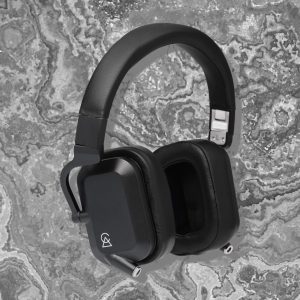
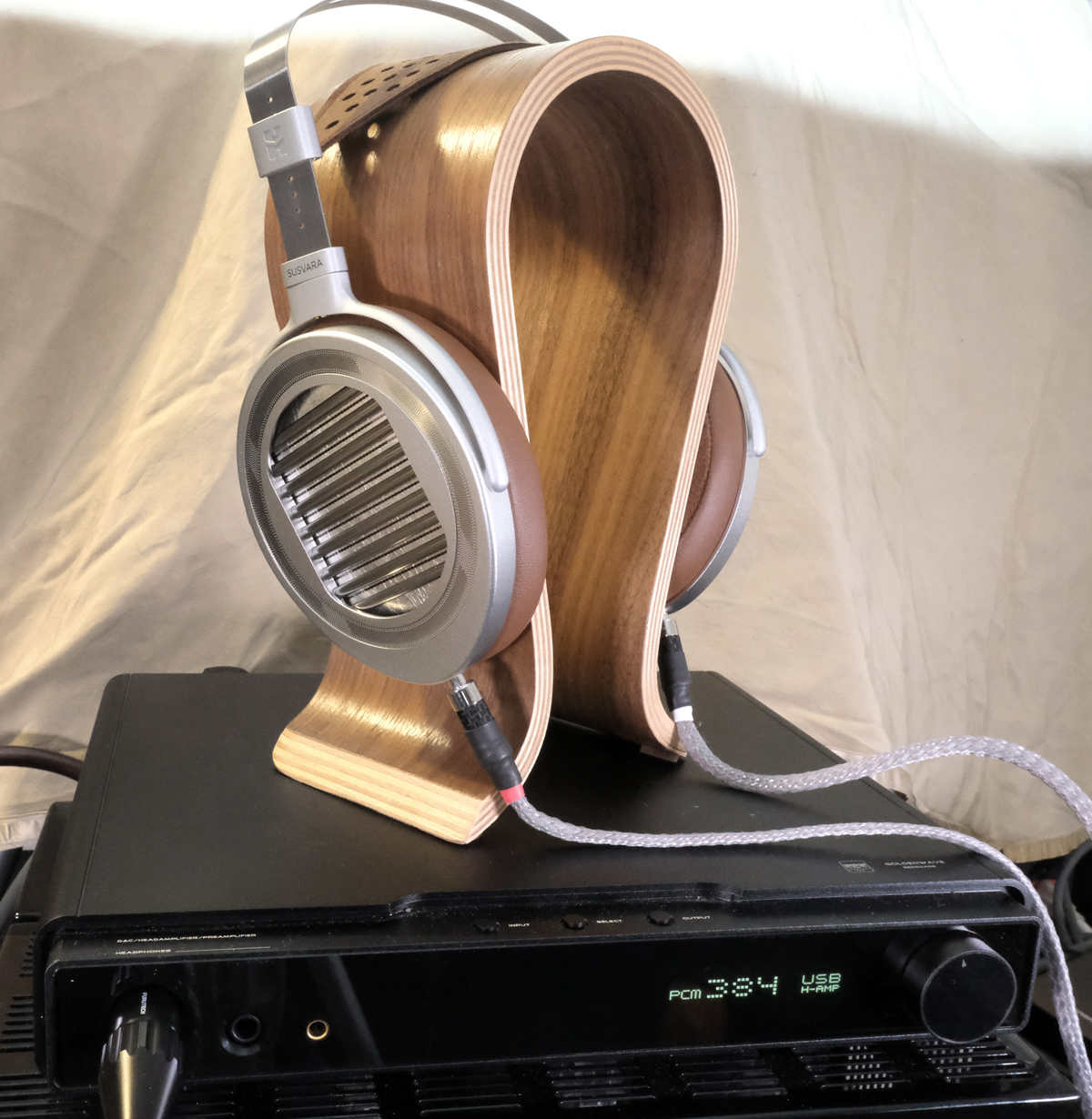
I have had the HIFIMAN GOLDENWAVE SERENADE DAC/Headphone Amplifier for a couple of months now, as many of you might remember, I used it for my review of the HIFIMAN ISVARNA Hybrid Headphone, and at that time, it was my intent to follow up with a review of the GOLDENWAVE SERENADE and use it as my new reference solid-state headphone amplifier. With the passing of my good friend Headphone.Guru publisher Frank Iacone, and the arrival of the dCS Bartók APEX DAC with Headphone Amplifier and the Dan Clark Audio CORINA Electrostatic Headphone along with the launch of the Meze 99 Classics 2nd Gen that review got pushed back a bit, and while the GOLDENWAVE SERENADE can easily compete with the headphone amplifier in the Bartók APEX, and as much as I love the HYMALAYA PRO DAC, I won’t pretend that it competes with a $24,000 DAC, hence while the GOLDENWAVE SERENADE will remain one of my reference pieces the Bartók APEX will probably remain as my go-to device.
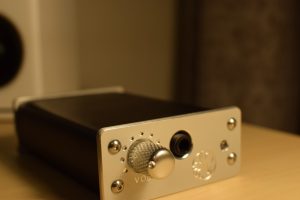
The HIFIMAN GOLDENWAVE SERENADE DAC/Headphone Amplifier
What we have in the HIFIMAN GOLDENWAVE SERENADE DAC/Headphone Amplifier is almost a one stop shop, amplifier, DAC, and WiFi that allows you to stream from a tablet or phone, plus support for a NAS as a music server, it even hand an analog input for use with an external phono stage, Reel to Reel Tape Machine, Tuner, or other analog source.
First and foremost, the GOLDENWAVE SERENADE is a discrete circuit Class A headphone amplifier with a massive 50Watt full-band Oxygen-free copper wire wound iron core toroidal transformer backed with nearly 30,000 microfarads capacitive storage and a multi-stage, multi-channel, low-noise, high-speed voltage regulator circuit to supply copious amounts of pure and fast current.
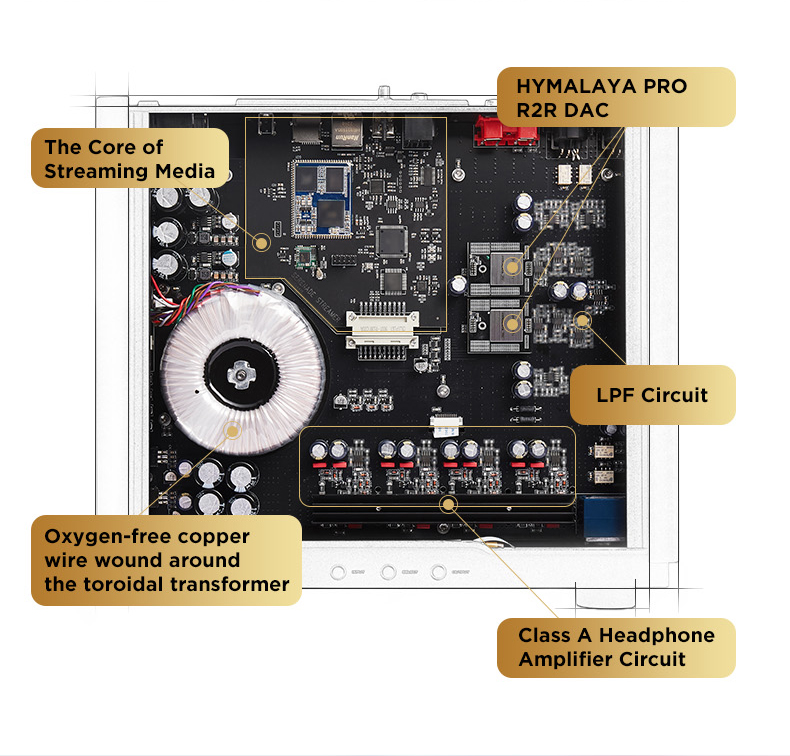
This is coupled to the HIFIMAN HYMALAYA PRO R2R DAC, with support from a new FPGA algorithm, employing 0.01% precision resistor for a THD of -6dB 0.0012%. The LPF analog circuit is discrete component using an FET operational amplifier. Adding to that, the Digital Module is upgradable.
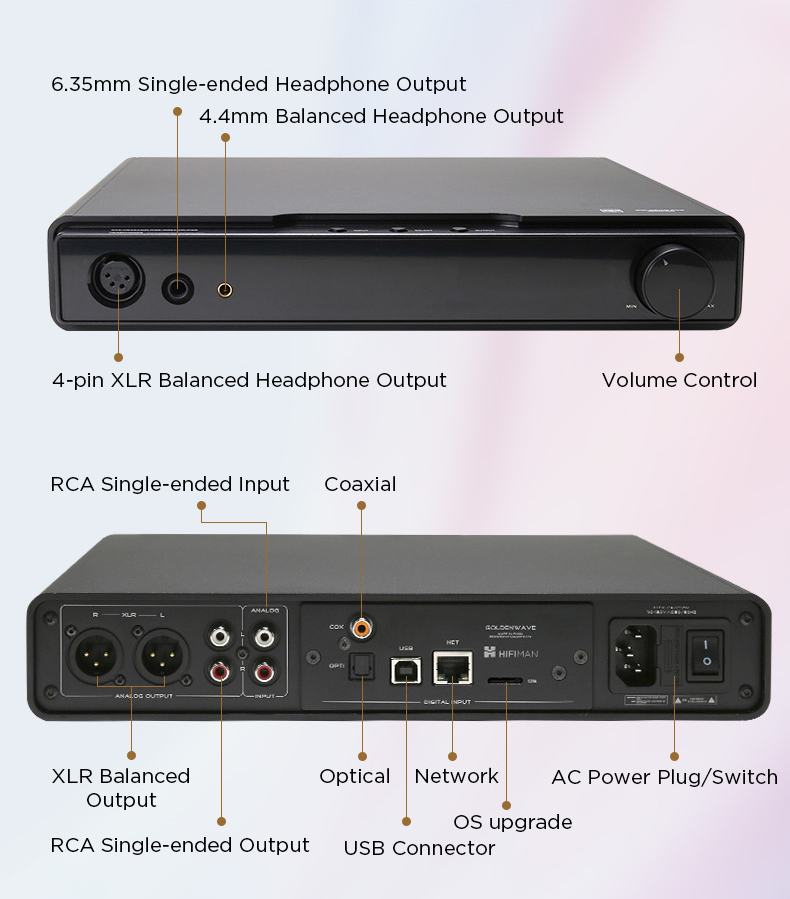
The chassis is unique and elegant, a sleek 2 ½” tall, 12” wide, and approximately 12” deep from the volume knob to the WiFi antenna. There are three buttons on the top, “input”, “select”, and “output”. On the front you have a 4-pin XLR Balanced Headphone Output, a 6.35mm (1/4”) Single-Ended Headphone Output, a 4.4mm Balanced Headphone Output, the display, and the volume control knob. While on the back, you will find 3-pin XLR Balanced line outputs, RCA Single-Ended line outputs, RCA Single-Ended analog inputs, an RCA Coaxial S/PDIF input, an Optical S/PDIF input, a USB-B connector, an RJ45 (CAT5/CAT6) Network connection, a Micro SD Card slot for OS upgrade, a power cable connector, and a power switch.
Living with the HIFIMAN GOLDENWAVE SERENADE DAC/Headphone Amplifier

Now by this time, the HIFIMAN GOLDENWAVE SERENADE DAC/Headphone Amplifier had plenty of miles on it, fitted with a Black Dragon USB Cable, a Black Dragon Power Cable, and Core Power Technologies A/V Equi=Core 1000, so the only question was which Headphones would be used to perform my serious listening tests. I decided to begin with my hardest to drive headphones, the HIFIMAN SUSVARA UNVEILED Planar Magnetic Headphone, using the Moon Audio Bronze Dragon Premium Headphone Cable. Launching Qobuz on my music server (I discovered that the XMOS USB driver in Windows would not pass the Qobuz sample rate defaulting to the preset sample rate in the Windows Sound settings, so I connected to the server which actually could be controlled by the Qobuz app in Windows) I selected “Mellon Collie And The Infinite Sadness (30th Anniversary Edition)” (24-bit/96kHz – Qobuz) by The Smashing Pumpkins. Dynamic and musical, the soundstage was large studio with the vocal occasionally moving up close and intimate and then stepping back to be several feet distant. The piano for the eponymous opening title track had a warm Yamaha in a parlor feel, solid and rich.

I followed this up with The Salt Collective and “A Brief History of Blindness” (24-bit/96kHz – Qobuz), another exciting upbeat and dynamic presentation, the soundstage felt multi-track recording with each instrument exhibiting a different spatial air, the vocals distant, while the keyboards appeared consol direct.
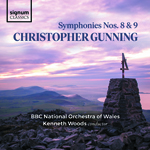
Wanting something classical to gauge timbre and tonal balance before switching headphones, I queued up “Gunning: Symphonies No. 8 & No. 9” (24-bit/96kHz – Qobuz) as performed by the BBC National Orchestra of Wales with Kenneth Woods, composed by Christopher Gunning. The massive soundstage was stunning, the cello plucks were visceral and resonant, the horns and woodwinds were natural, and there was a richness to the overall sound. The quick scrubbing of the bows across the strings created an in-the-room sensation, and the air between the performers gave the impression of a front row seat, and the image was laser solid.

Switching over to my favorite non electrostatic headphone the Dan Clark Audio STEALTH I went for some solo piano in the form of Víkingur Ólafsson, playing “Opus 109 (Beethoven | Bach | Schubert)” (24-bit/192kHz – Qobuz) the GOLDENWAVE SERENADE fully captured the extreme dynamics, the crisp high notes, the harmonic clash of the individual strings, while representing the fullness of the more mellow lower registers. I could actually hear the hammers as they fell.

Next up was The Replacements’ “Let It Be (Deluxe Edition)” (24-bit/96kHz – Qobuz), it was hard to believe that this clean, hard-hitting, articulate recording was made in the ‘80s. Clearly live studio recordings, the full soundstage of a single take recording was enveloping, making it easy to picture the artists a few feet away.

Sensing it was time to check out the DSD performance, I moved over to my test database and launched Sarah Vaughan singing “Lullaby Of Birdland” (DSD). You were about 10’ away from what sounded like a small stage in a large nightclub, with Sarah up front and the band behind, musical and detailed, exhibiting the analog characteristics of DSD.

As an extreme challenge in the opposite direction, I broke out my Noble Viking Ragnar IEMs, whose efficiency brings out the subtlest of noise floors, especially when connecting via 4.4mm TRRRS balanced. There was the barest of ambience without signal, and the base noise floor could be detected when the volume was turned up to about three-quarters (significantly louder than what I was able to stand with either of the previous headphones. With the volume all the way down, I could just hear the music when I started the track. Listening level was with the volume just cracked. The base tape hiss while listening to The Persuasions sing “Imagine” (“The Persuasions Sing the Beatles” – DSD) was quite noticeable prior to the a capella rendition’s commencement.
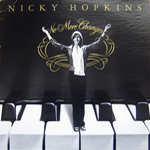
As a final test, I wanted to bring in a dynamic headphone using the ¼” single-ended output, in this case my Grado GS3000x Open Air Dynamic Headphones choosing Nicky Hopkins playing “Lady Sleeps” (“No More Changes” – 24-bit/96kHz vinyl rip) and I couldn’t be more pleased with the reproduction of one of my all time favorite songs. The percussion had impact, and the bass was rich and full with complex tonality, the piano natural and fully rendered, the soundstage was just vast, the organ had a life of its own, the Leslie present despite not being fully activated. And the guitar was sweet and true.
Conclusions on the HIFIMAN GOLDENWAVE SERENADE DAC/Headphone Amplifier
There is a reason I had chosen the HIFIMAN GOLDENWAVE SERENADE DAC/Headphone Amplifier as my solid-state reference DAC/Amplifier; it simply outperforms everything in its class and price range, it is only a quirk of fate that landed me with a DAC/Amplifier that costs over 20 times as much. As I said before, it will still get plenty of use reviewing mid-priced headphones that would be ill served by using a “price is no object” front end. Dynamic, musical, focused, and completely tonally balanced with the best chip-based DAC I have heard, the GOLDENWAVE SERENADE is probably the best value in a front end on the market, and as sneak preview, it is a strong contender for a Product of the Year Award, which I’ll be announcing later in the month.
Congrats HIFIMAN on another true winner, full thumbs up recommendation.
Price: $999
Manufacturer’s Website: https://hifiman.com/products/detail/339
Specifications:
Frequency Response: 20Hz-20KHz, ±0.1dB@1KHz
THD+N: 0.0015%, -3dBFS@1KHz
Signal to Noise Ratio: -110dB, 0dBFS@1KHz
Channel Separation: -120dB, 0dBFS@1KHz
DAC output level : 4.5V/XLR, 2.2V/RCA, 0dBFS@1KHz
Headphone amplifier power output: THD+N<0.07@1KHz
balanced output: 4000mW@32Ω, 760mw@300Ω;
single-end output: 2800mW@32Ω, 510mW@300Ω
Weight: ~3.9KG
Dimension: 300*255*50mm, protrusions not included
Package Contents:
Serenade DAC/Amp x1
Power Cable x1
USB-B Cable x1
Bluetooth Antenna x1

Want to join discussion?
Feel free to contribute!