
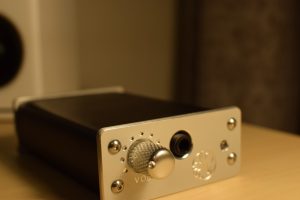

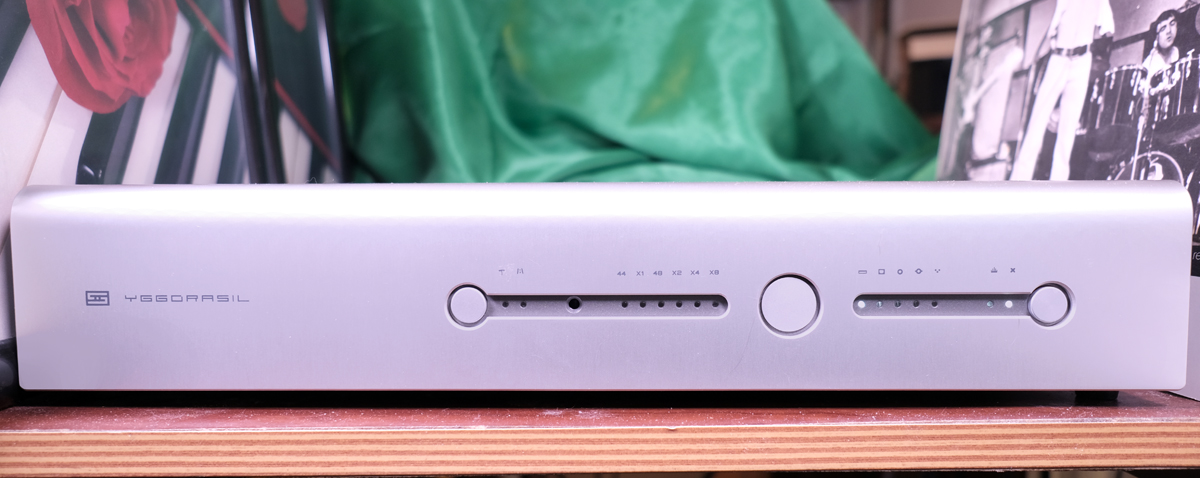
Schiit Audio has always hoed their own row, producing world-class American-designed and manufactured audio at about one-quarter market value. Based on designs from what is arguably the first enhanced resolution DAC originally developed in the 1980s and continually improved upon ever since, Schiit Audio has become synonymous with state-of-the-art DACs, and the Yggdrasil represents their flagship maximum effort offering, representing one of the few discrete DACs on the market. Unlike their very pricy competition, rather than focusing on software, they have focused on hardware, the only limitation being the converter chips themselves, leading them to create three different varieties of the Yggdrasil based on three different chips, one 16-bit, one 18-bit and one 20-bit (there are no true 24-bit DAC chips as current technology tops out at about 120 dB dynamic range and 24-bit requires something in excess of 144 dB dynamic range). Not satisfied with this limitation, the engineers at Schiit Audio have developed their own proprietary Singular™ FPGA-based delta-sigma modulator and discrete Nexus™ output stage, eschewing off-the-shelf DAC chips, resulting in the Yggdrasil Singular.
The Schiit Audio Yggdrasil Singular
According to Schiit Audio, the Schiit Audio Yggdrasil Singular is “the only DAC in the world with no purchased or canned functionality. Uses our proprietary Singular™ FPGA-based delta-sigma modulator and discrete Nexus™ output stage. Includes two Unison 384™ high-rate USB inputs, as well as standard Forkbeard™ system integration, preamp, and parametric EQ.”
At the heart of the Schiit Audio sound is a Unique Closed Form Digital Filter, a proprietary time- and frequency-domain optimized digital filter, implemented on a powerful Analog Devices DSP. This digital filter has a closed-form solution—it retains the original samples, performing a true interpolation offering selectable optimization of both NOS and upsampling designs.
As part of its Unique Digital Conversion Architecture, the Yggdrasil Singular uses the most advanced delta-sigma modulator (7 bits, 6MHz), based on thier proprietary math.
“Yggdrasil Singular is the only DAC in the world not using “canned” or purchased functions. Everything from the USB input to the digital filter to the delta-sigma modulator to the discrete output stage was developed by us. We don’t buy any USB receivers, DACs, digital filters, or even op-amps for gain or I/V conversion. It is a truly pure and singular vision of a DAC, from a team that includes the originators of the external DAC, Mike Moffat.”
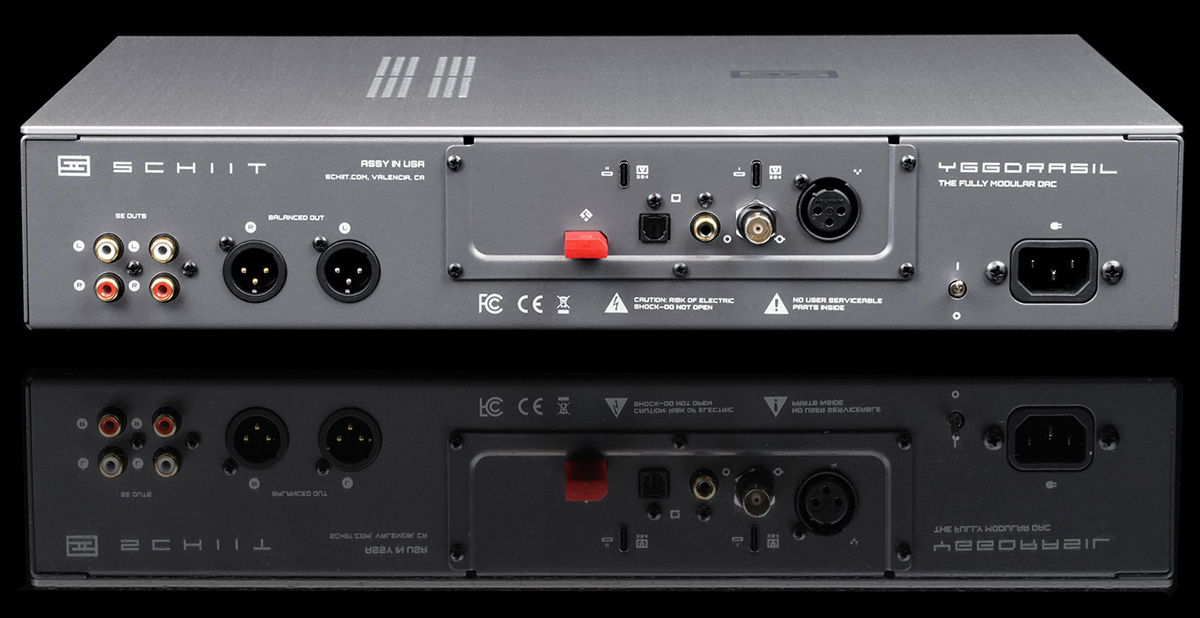
The Yggdrasil Singular includes a wide variety of inputs, including our Schiit Audio’s proprietary Unison USB™ interface with complete electromagnetic and electrostatic isolation. Both balanced and single-ended outputs, each optimized, are included. The standard remote control gives access to absolute phase inversion (a must for any audiophile DAC) and NOS mode on the fly to tailor the sound to individual track needs.
The Yggdrasil Singular also includes Forkbeard, Schiit Audio’s patent-pending system control and integration platform that gives the Yggdrasil Singular full digital preamp and EQ functionality, with control of volume, balance, parametric equalization, and Loudness compensation.
Schiit Audio offers, via the Yggdrasil, the flexibility and assurance of a truly modular architecture, both hardware and firmware. “Literally every board—from input to output—is replaceable, and its uniquely reconfigurable chassis provides for future expandability.”
And as mentioned above, the Yggdrasil Singular is Designed and Built in the USA
“By “designed and built in the USA” this is what we mean: the vast majority of the total production cost of Yggdrasil—chassis, boards, assembly, etc—goes to US companies manufacturing in the US. Our chassis and transformers are made in California. Our PCBs are made by us in Corpus Christi (or in California or Utah), and it all comes together in our San Antonio facility.”
Living with the Schiit Audio Yggdrasil Singular
To burn in the Schiit Audio Yggdrasil Singular, I used my HIFIMAN EF600 R2R DAC & Headphone Amp as amplifier since it had a balanced input and the new Dan Clark Audio AEON CORE Planar Magnetic Headphones (review pending), which of course also needed to be burned in. Hence, it only made sense to begin my listening tests with the EF600 and the HIFIMAN SUSVARA UNVEILED Planar Magnetic Headphone and Danacable Lazuli Rhapsody Headphone Cable.

Launching Qobuz, I began with “Exhale” (24-bit/48kHz – Qobuz) by Batu and Donato Dozzy. The soundstage was absolutely massive with blindingly fast transients; the digital kick drum was a bit soft, but as all the instruments were electronic synth, I didn’t see much else to be gleaned other than to say the sound was pleasant and musical.

My next choice was Lara Downes’ “Hold These Truths” (24-bit/96kHz – Qobuz) with accompaniment by acts 9 Horses and Invoke. The piano had a clear, deep, rich, and delicate Steinway in a huge hall sound, possibly the best piano rendition I have heard from a digital recording. The banjo, mandolin, and strings were so natural as to be magical.

The nylon string acoustic guitar for “Days Of Unrest” (24-bit/96Hz – Qobuz) by Margo Price was again imbued with such a sense of space as to give the impression that you were at the Grand Ole Opry.
It was time to migrate over to my reference system of LSA VT-70 Tube Integrated Amp with Black Dragon USB Cable, Black Dragon single-ended RCA Interconnects, Black Dragon Power Cables, and Core Power Technologies A/V Equi=Core 1000, and Dan Clark Audio STEALTH Planar Magnetic Headphone, though it was hard to imagine a more musical experience than what I had already achieved.
Queuing up my detail torture track “Birds of Fire” (“Birds of Fire” – Mahavishnu Orchestra – 16-bit/44.1kHz), which also has the benefit of being an extreme test for a DAC, being a low-resolution 44.1kHz track (the hardest thing for a DAC is to make low resolution sound like high resolution). Once more, the soundstage was epic in proportion, and the musicality made this recording sound as analog as I have heard it. So much so that I accidentally pushed the amplifier into overdrive (tube amps don’t really clip) until I remembered my HIFIMAN 4-pin XLR adaptor connected to the amplifier speaker outputs, giving me access to significantly more power. The cacophony of sound was resolved into eight individual musicians performing competing lead lines

Continuing with 44.1, I selected my sub-bass/tonal balance track, Dario Baldan Bembo performing “Non Mi Lasciare”, beautiful. What else is there to say, tonal balance was right on with extreme extension into the subsonic.

Because it can, I chose to play my 24-bit/352.8 track John Coltrane and “Locomotion”, this is the point where analog and digital meet, so it goes without saying, perfect.

Last test was NOS vs upsample; for this I used Tori Amos’ “’97 Bonnie & Clyde” (“Strange Little Girls” – 16-bit/44.1kHz), clearly the breadth of the strings increased massively with the upsample and the soundstage had more depth.
Conclusions on the Schiit Audio Yggdrasil Singular
Back in the ‘80s when I heard Mike Moffat’s original “Frankenstein” (the test bed for what would eventually become Theta Digital), I was blown away by the amazing detail it produced but knew that digital had a long way to go to match existing analog sources in musicality. At JPL at the time, using experimental DACs and a Studer Revox tube half-track 32-ips reel-to-reel machine (unfortunately I did not participate, but those that did were people whose ear I highly respected), a bar was set at 400kHz as the point at which a difference could no longer be perceived. Nowadays, though only available in relatively small quantities (software-wise), that bar is available to the general public, and the Schiit Audio Yggdrasil Singular has brought us to the edge of achieving that holy grail of audio quality deciphering lowly 44.1kHz recordings.
Without question, the Yggdrasil Singular is the best sound Schiit DAC I have heard, surpassing many DACs costing ten to twenty times more; it is that perfect synthesis of the right digital section matched with the right analog section producing exceptional detail paired with fastidiously accurate tonality, epic transient response, and luscious musicality.
If not totally unrivalled in sound quality in a price-is-no-object world, it is without peer in value; great work, Schiit Audio.
Price: $3,499 (black) $3,599 (silver)
Manufacturer’s Website: https://www.schiit.com/products/yggdrasil
SPECS THAT MATTER:
Distortion: inaudible; 100-1000x lower than any transducer (speaker or headphone) you’re using
Noise: inaudible; far below a typical speaker power amplifier
Input capability: accommodates all actual music recordings (upsampling for the heck of it, maybe not), up to 2 USBs!
Heat: runs moderately warm; this is normal and no need for panic
Size: suitable for typical stereo shelf or rack placement, not desk-friendly
Inputs: 2x Unison 384™ USB, AES/EBU XLR, RCA SPDIF, BNC SPDIF, Optical SPDIF
Input Capability: up to 32/384 for Unison 384, up to 24/192 for other inputs
Input Receiver, SPDIF: AKM AK4118 with post-processing
Input Receiver, USB: Unison 384™, based on Microchip PIC32 microprocessor
Clock Management: Bitperfect clock management via programmable oscillators and algorithmic assessment
Digital Filter: proprietary Schiit time- and frequency-domain optimized digital filter implemented on Analog Devices SHARC DSP processor
Frequency Response, Analog Stage: 20Hz-20Khz, +/-0.2dB, 0.5Hz-170KHz, -1dB
Maximum Output: 4.0V RMS (balanced), 2.0V RMS (single-ended)
THD+N: -102dB referenced to full output (0.0008%)
IMD: <0.0009%, CCIF, at full output
SNR: > 108dB, referenced to 4V RMS
D/A Conversion: Schiit Singular™ 7/6 delta-sigma modulation, Xilinx FPGA+ and high-precision discrete resistor ladder, hardware balanced configuration
Analog Stage: Schiit Nexus™ differential fully discrete Class A
Output: One pair XLR balanced and two pairs RCA single-ended
Output Impedance: 75 ohms
Power Supply: two transformers (one for digital supplies, one for analog supplies) plus one input choke for discrete, dual mono, shunt-regulated analog +/-24V supply, plus 12 or more separate local regulated supplies for DACs and digital sections, including high-precision, low-noise LM723 regulation in critical areas.
Upgradability: Fully modular architecture. Separate digital input board, USB input board, DSP engine board, and DAC/analog output boards.
Power Consumption: 45W
Size: 16 x 13” x 2.875”
Weight: 25 lbs
APx555 Report for Yggdrasil Singular
Yggdrasil is covered by a 5-year limited transferrable warranty that covers parts and labor. And if you don’t like your Yggdrasil, you can send it back for a refund, minus 5% restocking fee, within 15 days of receiving it.

Want to join discussion?
Feel free to contribute!